
Causes of a Car Starting Then Immediately Stopping. What’s more frustrating than a car that starts for a few seconds and then completely shuts off, and this happens every time you try?
Not much, if you ask me! You should know that this is a fairly common problem, so you are certainly not alone, and there are easy solutions to this issue.
In this article, we will go over the 10 most common reasons why your car starts and then dies immediately.
Here is a more detailed list of the most common reasons why your car starts and then dies:
Lack of Fuel
The most common reason why your car starts and then dies is due to a lack of fuel in the engine. This often happens because there is a small amount of fuel in the fuel rail, which helps the engine start, but there is no fuel pressure to keep the engine running.
Lack of fuel is, however, quite easy to diagnose. You can either connect a fuel pressure gauge to the fuel rail or carefully loosen a bolt while starting the engine to see if you have fuel pressure. Be careful so you don’t set anything on fire.
If you realize that your car has low fuel pressure,
Anti-Theft Alarm System
The second most common thing is any issue with the anti-theft or anti-theft alarm system. When the anti-theft system is activated, the car does not send any power to the fuel pump, which creates fuel pressure in the fuel rail. This will cause the car to start for a few seconds, as we have already discussed.
If the anti-theft alarm system is factory-installed, you should have a key symbol on your dashboard that should turn off a few seconds after turning the ignition on. If it doesn’t, try locking and unlocking your car and try again. If it is still on, there may be a problem with your car key.
If you have an aftermarket anti-theft alarm, there may be a problem with the alarm itself or a faulty remote.
Dirty Fuel Filter
If the car stops after turning the ignition on, the problem could be a lack of fuel, as we have already discussed. A fuel filter is a common thing that causes low fuel pressure.
The fuel filter is a filter that you need to replace on a schedule, which depends on your car model. If you haven’t replaced it for a long time, it may be clogged.
Fuel filters are often quite easy to replace and inexpensive. If you have low fuel pressure, it may be worth trying to replace it.
Bad Idle Control Valve
The function of the idle control valve is to maintain your car’s idle. Newer cars control the idle with the throttle body, but if you have an older car with a throttle cable, you have an idle control valve.
Often, this idle control valve can get dirty, which will prevent the idle from functioning properly. You can try cleaning this valve to see if it improves. Otherwise, you need to replace it or repair the wiring.
Vacuum Leak
The throttle body or idle control valve controls the idle by regulating the amount of air entering the intake manifold. If you have a major vacuum leak, it can actually make the car’s air-fuel mixture too lean and cause it to die after a few seconds every time you try to start your car.
Vacuum leaks are often quite easy to locate, either by using an EVAP smoke machine or simply by listening for the leak, as it will often cause a high-pitched sound.
Faulty Spark Plugs
The combustion engine works by igniting an air-fuel mixture. The spark plugs provide the spark for this ignition. The pistons move up and down, which causes movements in the crankshaft and wheel axles.
If the spark plugs are faulty, the ignition will fail and the car will stop moving. This can cause the car to start for a second but misfire too much with a weak spark, so the engine will die very soon.
Fuel Injector
Fuel is injected under high pressure into the combustion chamber using the fuel injectors. The job of the fuel injectors is to regulate so that the exact amount of fuel needed enters the combustion chamber.
If a fuel injector fails, it can cause the engine to run on fewer cylinders and also cause a drop in fuel pressure if one of them is stuck open.
You can try to feel the fuel injectors with your hand during startup to see if they click. If they don’t make any clicking sound, one of them may be faulty.
Faulty Ignition Switch
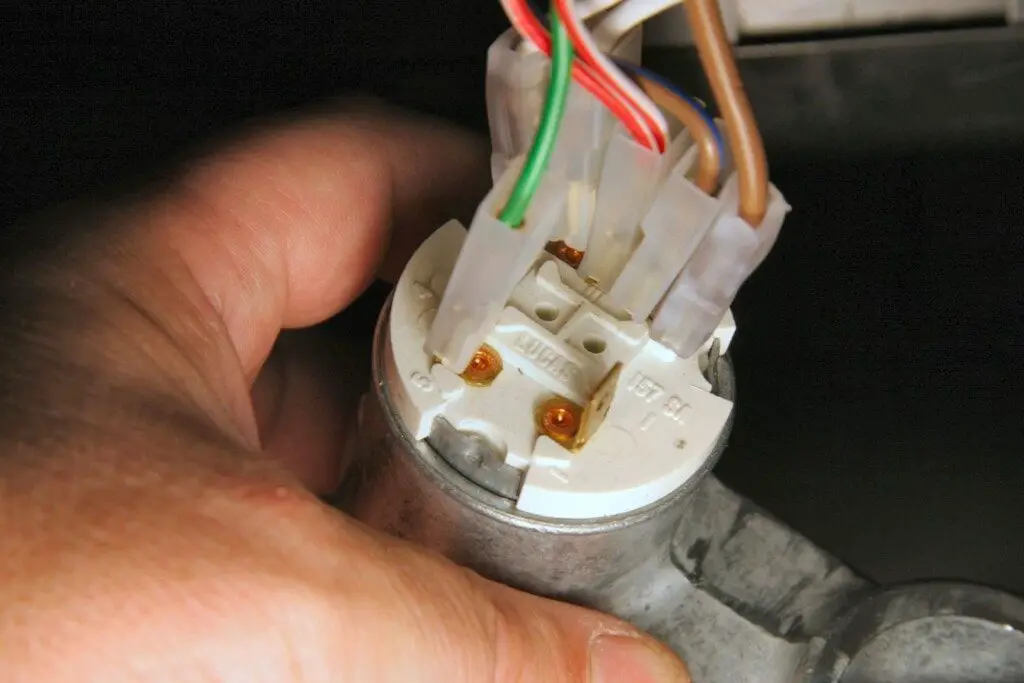
If your ignition switch is damaged, you can start the car normally, and after a few seconds, the car will stop completely. If your ignition switch is faulty, you need to check the wear on the switch contacts.
The ignition switch is located behind the car’s ignition lock. In newer cars, it is most often not possible to replace the ignition switch itself; you have to replace the entire ignition lock.
Faulty EGR Valve
The EGR valve controls the exhaust gases that need to be recirculated into the engine. If the EGR valve is stuck open, it can allow too much air into the intake manifold.
This can make the mixture too lean, which will also cause the car to start and then die after a few seconds.
Engine Control Unit (ECU)
The ECU is a computer system that controls various engine functions, including the fuel injection system. Since a vehicle needs fuel to move, any malfunction of the ECU will cause the vehicle to stop after starting.
The ECU controls engine components via a series of sensors. Over time, sensors become faulty and transmit incorrect information to the ECU. In this case, you need to take your car to an auto repair shop.