


Few circumstances can ruin a day as quickly as the sudden appearance of a strange noise while driving. When it comes to vehicles, strange noises manifest in all manners and frequencies, often leaving the driver unaware of what they heard or where it came from.
If prominent enough, strange vehicle noises can be quite exasperating and very frustrating to diagnose. Some of the most common, yet aggravating, irregular vehicle noises are those that present a whining or droning noise during acceleration.
In truth, there are many potential causes for this type of sound alone, which usually requires extreme attention to detail during the diagnostic process.
Read on to learn more about what to do if your vehicle starts emitting whining noises, as well as the potential causes of these sounds.
Common Causes of Whining Noise When Accelerating
There are quite a few potential causes for your vehicle’s whining noise, many of which are frequently heard by countless motorists on an annual basis. Here are some of the most common causes of vehicle whining during acceleration.
- Internal transmission problems
- Worn alternator bearings
- Damaged water pump bearings
- Low power steering fluid
- Faulty A/C compressor
- Idler pulley/tensioner problems
- Dry, cracked, or slipping serpentine belt
- Worn wheel bearings
What follows is a more in-depth explanation regarding the individual causes of vehicle whining listed above. For simplicity’s sake, these causes have been subdivided into four distinct categories.
#1 – Transmission Issues
A vehicle’s transmission performs an extremely vital function and is essential for distributing engine power to the drive axles of a car, truck, or SUV. Unfortunately, transmissions are prone to internal failures with age.
In some cases, a failure of this nature can present an audible whining noise. Noises of this type can often prove difficult to locate, especially when they resonate from a vehicle’s transmission tunnel.
A whining noise from your vehicle’s transmission typically indicates a fluid-related problem. It is quite common to hear a noise of this nature when a transmission’s fluid level is reduced beyond its capacity or when a transmission fluid pump begins to fail.
Additionally, a failing torque converter can also present a whining noise. Internal bearing wear often presents a roaring noise, which can be mistaken for a whine at high speeds.
Severity
In most cases, the appearance of a whining noise from a vehicle’s transmission is considered quite serious by nature. In the case of a faulty torque converter, replacement will require the removal of the transmission.
The cost associated with such repairs is often high and typically exceeds $1,000. If a faulty internal bearing is to blame for your transmission’s noise, the associated repair cost will be exponentially higher.
#2 – Bearing Wear of Belt-Driven Components
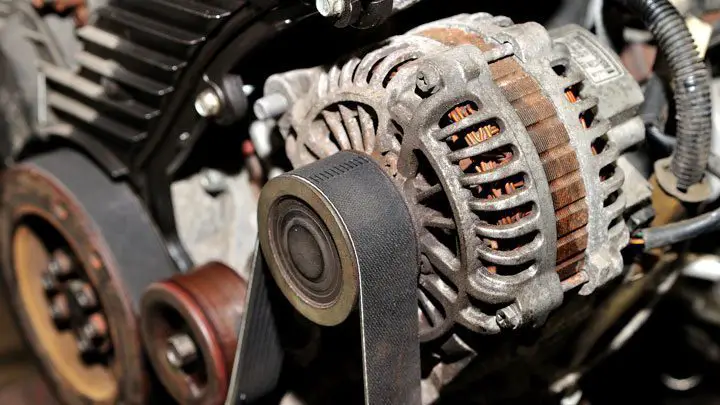
A vehicle’s engine has many belt-driven accessories. Each of these accessories uses a drive pulley, as well as one or more sets of bearings.
A serpentine belt transfers rotational force from the crankshaft pulley to the pulleys associated with various additional belt-driven accessories. These accessories include a water pump motor, power steering pump, A/C compressor, and the alternator. Additionally, systems of such design also feature tensioners and idler pulleys.
When the bearings associated with any of the aforementioned components begin to fail, a whining noise is often heard. The most relevant example of this situation perhaps presents itself in the form of an alternator with bad internal bearings. When these bearings fail, a loud whining or screeching noise can be heard over the sound of typical engine operation.
Power steering pumps also tend to present a fair amount of noise with sufficient wear. Alternatively, one can expect to hear such sounds when a power steering pump is low on fluid.
Severity
Faulty accessory drive components also require prompt diagnosis and replacement. Failing to address these issues can lead to seized bearings and a shredded belt, ultimately leaving you stranded on the road.
Since most modern vehicles rely on a single serpentine belt to drive all associated accessories, a single locked-up component can render the rest of a vehicle’s belt-driven accessories unusable.
#3 – Dry, Cracked, or Slipping Serpentine Belt
As mentioned above, a vehicle’s serpentine belt drives a number of components that are essential to the vehicle’s operation. However, a belt can only drive these accessories if it is in optimal shape.
Over time, a serpentine belt can begin to dry out and crack. As a result, a belt is unable to grip the pulleys of the various accessories it drives as effectively as desired. This inevitably leads to belt slippage, the severity of which only increases over time.
As a serpentine belt slips along the outer diameter of various pulleys, the resulting friction can produce a significant amount of noise. These sounds are perhaps best described as a whining or squealing noise, which tends to increase in intensity during acceleration. This additional friction can also further damage an already worn serpentine belt, ultimately leading to failure.
Severity
In many cases, the whining or squealing of a serpentine belt is more of a nuisance than anything else and carries little risk of creating additional problems if not addressed immediately.
However, a severely worn or damaged serpentine belt can break or be thrown from the pulleys it rides on. When this happens, the function of all belt-driven accessories will be compromised, ultimately leaving you stranded.
#4 – Worn Wheel Bearings
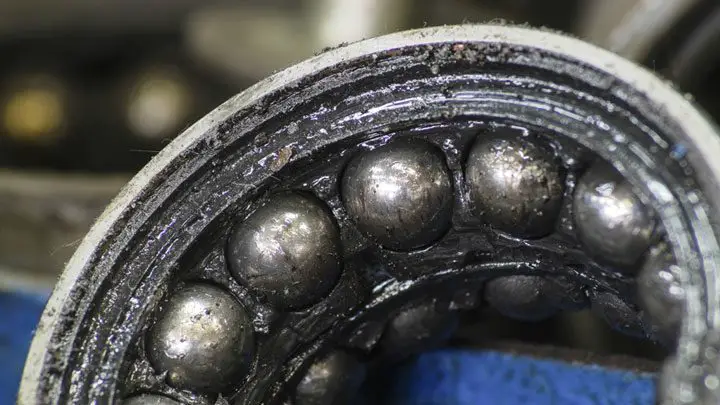
Wheel bearings have the responsibility of ensuring that our vehicles’ wheels rotate freely as they travel down the road. These bearings are often contained within a unitized hub, which must be replaced if the bearings housed within begin to wear out.
Alternatively, many older vehicles featured independent wheel bearings, which could be removed and repacked with grease if necessary. Unfortunately, regardless of type, wheel bearings tend to wear out over time.
In the vast majority of cases, a severely worn wheel bearing will make a roaring noise as a driver moves down the road. This noise typically changes pitch as the vehicle accelerates. At high speed, this sound often resembles a droning or whining noise.
One can often identify a faulty wheel bearing during turns. If the sound in question changes pitch or ceases altogether mid-turn, a vehicle’s wheel bearings become suspect.
Severity
Excessively worn or damaged wheel bearings should be replaced as soon as possible. Failing to do so will only lead to increased wear, further worsening the problem.
When they reach a point of total failure, the rollers found in a wheel bearing’s cage can dislodge and come loose, creating a dangerous amount of free play in a vehicle’s hub.
In the most extreme cases, an excessively worn wheel bearing can cause a hub to rest freely on its axle. This presents a dangerous situation, which can ultimately cause a wreck or severely damaged wheel end components.