

In a perfect world, we would spend our entire lives driving from point A to point B, without fear of being involved in a collision. Unfortunately, wrecks occur frequently and incessantly on our country’s roads. When such collisions occur, our vehicles often bear the brunt of our misfortune.
If you’re lucky, a minor fender dent will result in little more than a few cosmetic flaws, all of which can be repaired with relative ease. This can be as simple as making a dent or repainting a bumper.
However, at the other end of the spectrum, the most violent collisions often leave behind significant mechanical damage, which is much harder to repair (or even see).
Of these damages, none is as significant as that which extends to a vehicle’s frame. When the frame is damaged, the chances of a vehicle being totaled skyrocket, as it often serves as the proverbial nail in the coffin for all but the newest vehicles. However, one must often wonder how severe such damage can truly be.
Read on to learn more about the severity of structural damage to a car, truck, or SUV’s frame, as well as the typical costs associated with repairing such damage.
What is a Car Frame?
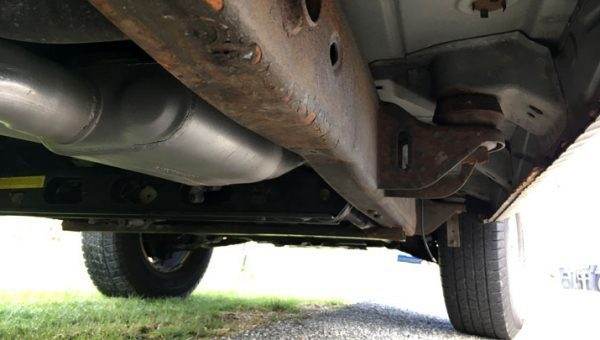
A car frame serves as the very foundation upon which the rest of a vehicle is built. A “frame” essentially consists of two main rails, which extend the entire length of a vehicle and are fixed by a number of crossmembers at varying intervals.
Although the exact design of a vehicle’s frame often varies from one particular make and model to another, all serve the same purpose. From a vehicle’s body to its drivetrain components, all are attached to this central frame at a particular point in its construction.
A vehicle’s body is mounted onto the frame below, via specialized body mounts. A vehicle’s engine and transmission are held in position by mounts supported by the frame. Essentially, without a well-designed frame, a vehicle simply would not exist.
Vehicle frames are also carefully designed to incorporate specific angles, which ultimately influences characteristics such as drivetrain inclination and front-end geometry. The slightest variation in these angles can present a multitude of handling-related issues.
What is Considered Frame Damage?
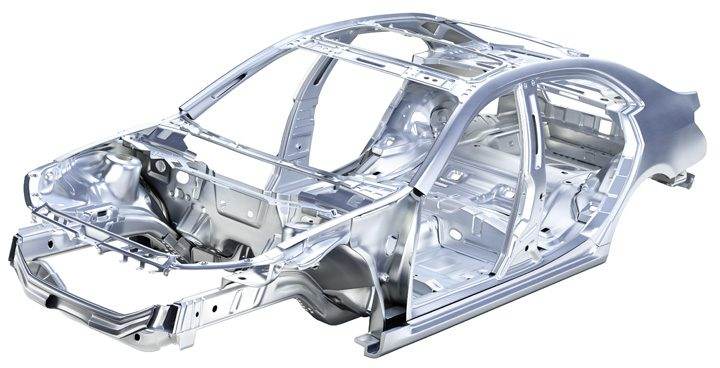
Any damage that extends to a vehicle’s main support structure or compromises a vehicle’s structural integrity is classified as frame damage.
The most common example of this form of damage is that which results in a bent frame. This occurs when an impact sustained during a collision is significant enough to deform a vehicle’s main support structure.
Damage to any permanently riveted or welded mounting point on a vehicle’s frame can also be classified as frame damage. This includes damage that extends to a vehicle’s upper suspension mounts or crossmember mounting flanges.
Signs of a Car With Frame Damage
When considering the purchase of a used car, there are several telltale signs of frame damage that any potential buyer should be aware of. Here are several key characteristics of frame damage to watch for.
#1 – Non-Uniform Bends In Frame
In most cases, if a bend in one frame rail does not match that of the rail on the opposite side of the vehicle, frame damage should be suspected.
Most manufactured bends in frame rails are identical from one side of a vehicle to the other, are identical and extremely uniform in appearance.
#2 – Drastically Altered Alignment
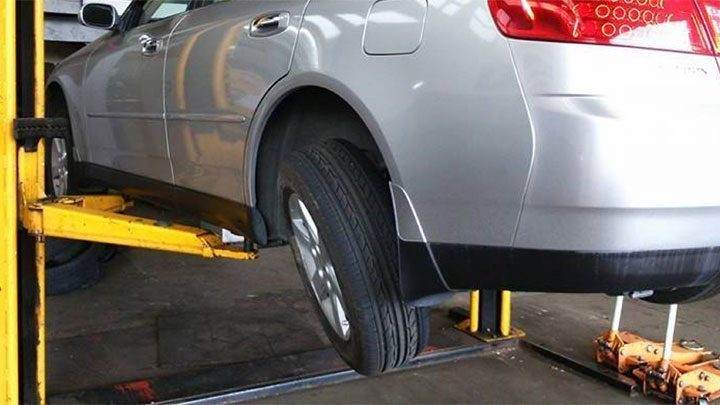
A vehicle’s front end can become misaligned for a number of reasons. However, a drastic misalignment, which is very visible to the naked eye, is usually a dead sign of frame damage.
Do not be fooled into believing a seller’s claims that the vehicle in question will be fine after a quick alignment.
#3 – Unnaturally Positioned Suspension Components
If a quick glance inside a vehicle’s wheel well reveals a shock absorber or strut leaning at an unnatural angle, which does not match that at the opposite end of the same axle, look elsewhere.
Mispositioned or misaligned shock absorbers/struts indicate that significant frame damage has altered the location of a vehicle’s suspension mounting points.
#4 – Ill-Fitting Components
If a number of a vehicle’s body panels and accompanying components appear to have a poor level of fit and finish, there is a high likelihood that substantial frame damage is to blame. Even a door that does not close properly can sometimes indicate that there are more serious issues at hand.
This is especially true if all of these panels and components appear to be new but bind poorly when moved. In many cases, a vehicle’s frame has been deformed to the point of altering the location of its body mounts.
#5 – Irregular Tire Wear
Tires can wear unevenly for a number of reasons. However, if several different wear patterns are present among the tires of a single vehicle, there is a high probability that frame damage is to blame.
When a frame has been damaged to the point of altering its geometry, a vehicle’s tires will often track irregularly when driving on the road. This almost always leads to extremely strange tread wear.
Can Frame Damage Be Fixed or Is the Car Totaled?
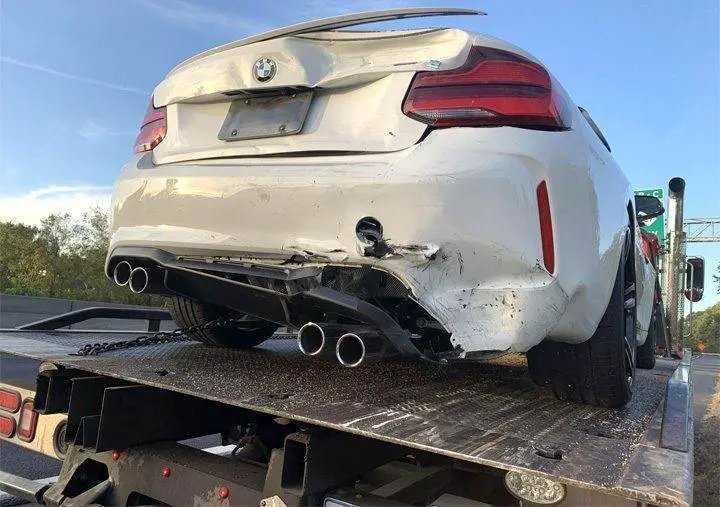
The viability of repairing a car’s frame is dictated by the extent of the damage sustained. In some cases, when this damage is relatively minor, a vehicle’s frame can indeed be repaired.
However, in other more severe cases, frame damage is totally irreconcilable.
When frame damage is severe enough to require a lot of time, effort, and money to perform the necessary repairs, it is not always feasible or safe.
Not only would the expenses associated with such repairs likely exceed those of most vehicles in their entirety, but a frame that has already been repaired is never as strong as it was before being damaged.
As a result, even if a frame could be repaired, doing so presents a huge liability. For this reason, many shops quickly veto the idea of repairing any frame deemed excessively twisted or deformed.
Frame Damage Repair Cost
The cost associated with repairing frame damage can vary significantly from one end of the spectrum to the other and largely reflects the severity of such damage.
In almost all cases, a vehicle will need to be placed on a specialized piece of equipment known as a frame rack, through which precise repairs can be made. Services of this nature are never cheap and typically require a fair amount of time.
At the lowest end of the price range are damages contained within suspension mounts, which are typically riveted/welded in place at the factory. Even repairs of this type can be quite costly and often result in labor costs between $1,000 and $2,000.
Worse yet, this estimate does not include the cost associated with repairing additional cosmetic damage that will also have occurred during such a collision.
At the other extreme of this price range is the cost associated with repairing a severely damaged or twisted frame. It is not uncommon for repairs of this type to exceed $10,000 in cost, before the replacement of external cosmetic components.
Few cars undergo such extensive repairs, as it is rarely feasible.
Is It Safe to Drive a Vehicle With Frame Damage?

Simply put, it is never safe to drive a vehicle with unrepaired frame damage. When such damage occurs, a vehicle’s structural integrity is compromised. As a result, a subsequent collision of any kind could have disastrous consequences.
Furthermore, since frame damage often alters a vehicle’s front-end geometry, handling usually suffers. This can result in unbalanced steering, as well as uneven weight distribution, both of which can increase the chances of you ending up in a wreck of one type or another.
If that is not convincing enough, it is also important to understand that you could be held liable if you were to injure another motorist in a wreck, while knowingly driving a vehicle with unrepaired frame damage.
Therefore, you could jeopardize the livelihoods of several people by driving a vehicle that has been damaged in this way.
Can You Sell a Car With Frame Damage?
The legality of selling a frame-damaged vehicle generally differs from one state to another. However, in almost all cases, a seller is legally required to disclose details regarding such damage prior to sale. If you fail to disclose this information, you quickly risk becoming the target of a lawsuit.
Furthermore, failing to disclose frame damage when selling a vehicle can also get you in hot water civilly, and perhaps criminally, if the vehicle’s new owner were to be injured in a collision related to such damage.
Essentially, providing potential buyers with a detailed account of any known frame damage is not only the best way to proceed, but truly the only course of action.