
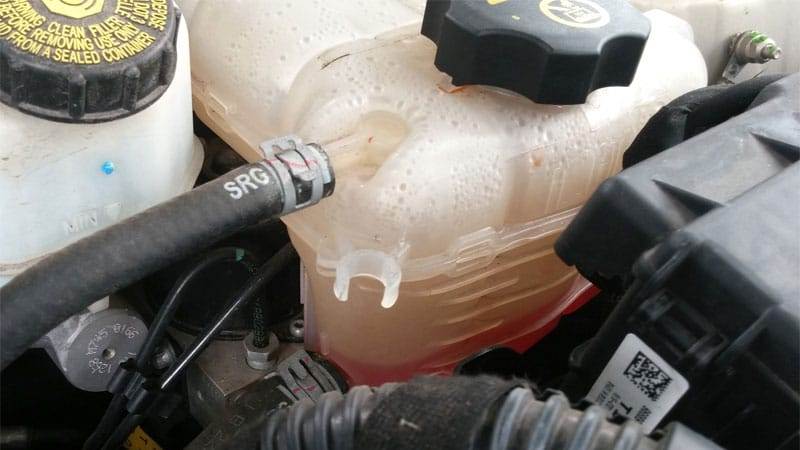

During car operation, drivers must have encountered a situation: boiling coolant in the reservoir or bubbles in the coolant reservoir. What will happen to your car?
Our answer is: If you don’t act in time, it can damage your engine. So, if you’re looking for the reasons and how to handle the above phenomenon, this article is written for you.
Is Coolant Really Necessary for Your Car?
When the engine runs, the air-fuel mixture is burned in the engine cylinders, producing a huge amount of heat. However, only part of the heat is successfully converted and the rest is dissipated, causing the engine temperature to rise. If the engine temperature exceeds the allowed threshold, the oil won’t have a good lubricating effect, leading to increased friction and rapid wear and damage to machine parts.
That’s why your car needs coolant. Engine coolant is a liquid mixture of water and antifreeze located in a vehicle’s radiator. As its name suggests, coolant functions to “cool” your engine, thus contributing to smoother car operation. More specifically, coolant will limit engine overheating in hot climates and freezing in extreme cold. Additionally, this fluid can also prevent rust and corrosion of the parts it flows through, including the radiator, heater core, and pump.
If you’ve read this far, you probably know the importance of car coolant. When your car lacks coolant, your engine will definitely overheat and the temperature will rise during operation. This can cause an explosion, which is extremely dangerous. Stalling your car in the middle of the road in traffic. At the same time, it affects the car’s components.
What is the Boiling Point of Car Coolant?
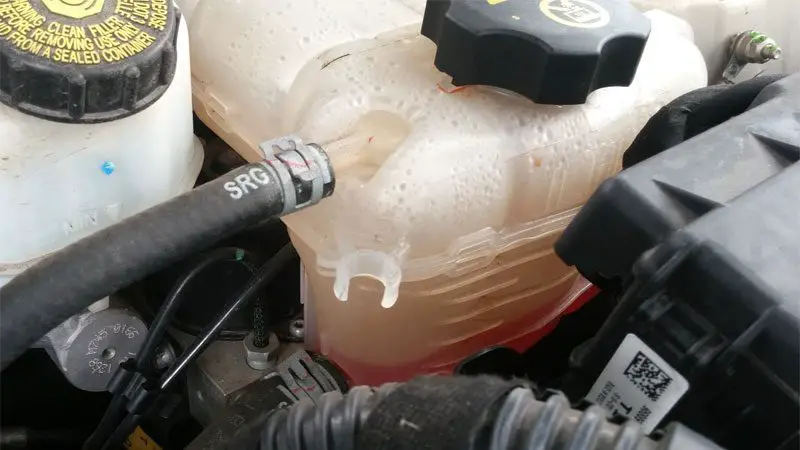
Knowing the boiling point of antifreeze or coolant is very important for drivers. So when we talk about coolant or antifreeze, what is their boiling point? As we know, 212°F is the boiling point of pure water and it freezes at 32 degrees Fahrenheit. However, the boiling point of your car’s coolant is higher than water’s, coolant boils at temperatures between 300 and 400 degrees Fahrenheit.
When choosing coolant for your car, the important factor to consider is your country’s climate. If you are in cold weather, you should take coolant with a higher boiling point as it will help your engine not to freeze. Otherwise, in a hot climate, you can choose the coolant or antifreeze that has a lower boiling point. Make sure to check your manufacturer’s recommendations before deciding to buy the coolant or antifreeze.
Why is My Coolant Boiling in the Reservoir?
It’s an abnormal situation when your coolant boils during the driving process. Your car’s coolants will start to boil or bubble when the engine temperature rises above the boiling point level. We can say that all reasons for engine overheating can also lead to coolant boiling.
Diagnosing the cause early can help you minimize damage to your car. Some faults cause the coolant to boil in the reservoir, but the most common are the following:
Damaged Head Gasket
A head gasket has an essential role in sealing your engine’s combustion chamber so your car can perform compression to maintain engine power and avoid harmful emissions from combustion. However, the most important function is to prevent coolant from leaking elsewhere.
What happens If your head gasket is blown, a head gasket failure will cause your engine to run under extreme conditions with overheating because, at that time, it allows engine coolant, gas, and oil to mix. And when the temperature in the engine reaches a boiling point, it will make your coolant boil in the reservoir. If you notice white smoke coming from under the hood or the coolant light turns on, immediately check the coolant reservoir. Furthermore, when the head gasket fails, air can seep into the coolant reservoir and cause the bubbling phenomenon in your fluid.
Bad Cooling Fan
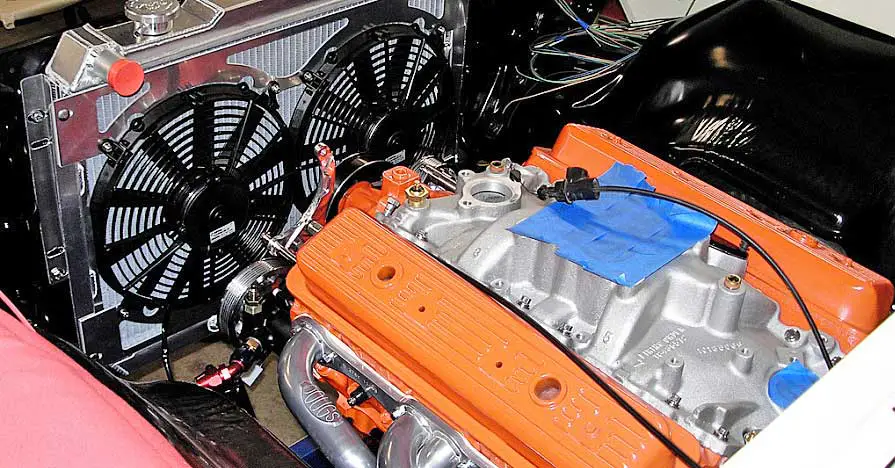
When the car is running, the excess heat generated during air compression, fuel combustion, and mechanical part friction must be dissipated. The car radiator fan’s role is to coordinate with the coolant to increase the engine’s cooling efficiency when the above heat is released.
If your cooling fan breaks due to a blown fuse, damaged wire, faulty fan clutch, or corrosion, it will make your coolant boil in the reservoir because the fan doesn’t provide sufficient airflow when your car stops. Regardless of the cooling fan configuration, its main goal is to cool the coolant. If it fails in one way or another, you may find your coolant boiling.
Faulty Thermostat
The main symptom of a bad thermostat is related to your engine overheating. This can be easily detected as your car’s temperature gauge may be abnormally high. Valves stuck in the closed position can be the reason for this situation. As a result, the coolant won’t be able to flow and will boil.
A thermostat’s function is to open and close at the correct intervals to regulate coolant entering and leaving the radiator. When this part doesn’t work properly, it won’t open at the exact time and will cause the cooling system to overheat.
Faulty Radiator Cap
The radiator cap is often overlooked in maintenance, but it’s considered a crucial element of the cooling system. A radiator cap is essentially a relief valve; when the coolant reaches a high temperature, the relief valve opens and ensures your cooling system remains under pressure.
When this cap is stuck, it doesn’t have the ability to maintain enough pressure to lower the coolant’s boiling point, causing inadequate heat absorption from your engine. The engine can also overheat due to air pockets in the coolant caused by the malfunctioning radiator cap and the rapid expansion of air at high temperatures. This will make the coolant boil in the reservoir.
Water Pump Not Working Properly
Water pumps typically last 100,000 miles or more on average, but given the fundamental role they play in regulating engine temperature. It’s the part that continuously injects coolant into the car’s engine to prevent the engine from overheating.
What happens if your water pump fails? It will cause your engine temperature to reach a dangerous level. This is usually indicated by a high engine temperature or an engine temperature warning light on the dashboard. At that point, the coolant becomes hot, boils, and emits white smoke while increasing the heat of the entire car.
Coolant Level
Driving with low coolant will create an airlock in your cooling system and create liquid foam. The airlocks will disrupt the cooling system’s flow, leading to engine overheating. You might notice the warning that your coolant level is low due to the light on your dashboard, but if you don’t, the common consequence is that your engine will start to boil and spew steam – this will result in more steam from your engine.
Clogged Radiator
When you notice your coolant starting to boil, remember to check the radiator. Like other car parts, radiators can also be affected by the consequences of wear and tear. Eventually, debris can get into the radiator and start to clog it. Remember, the radiator is very important for ensuring the proper functioning of the cooling system. So when your radiator gets dirty, engine overheating is the popular result, and of course, it will make the coolant temperature abnormally high.
How to Deal with Coolant Boiling in the Reservoir?
As we mentioned in the part above, there will be many reasons why your coolant boils in the reservoir. So, if you don’t identify the exact cause, it can lead to serious consequences for the engine. Therefore, you need to take the car to a mechanic to determine the cause of the coolant boiling and then repair it immediately. But if you want to know how to fix it, here are some fixes you can refer to.
Change the Bad Thermostat
When the thermostat is stuck, it prevents coolant from circulating in the engine to the radiator. In this case, replacing the thermostat is an unavoidable thing. Replacing or solving a bad thermostat problem can be a fairly easy task for most DIYers, while others don’t know where to start.
If you have good experience in car repair, you can replace the thermostat by yourself, otherwise you can entrust your car to a trusted mechanic. The cost of replacing a thermostat ranges between $70 and $450, depending on your car model and labor costs. A thermostat costs about $20 to $50, and factory labor costs between $50 and $400.
Fix an Air Pocket in the Reservoir
You can easily fix the problem by properly filling it with coolant. At the same time, when changing the coolant, used air is trapped inside the reservoir, causing air bubbles and making the coolant temperature rise. Therefore, to ensure there is no air in the reservoir, start the engine with the radiator cap closed. This will help remove air from your reservoir.
Replace the Faulty Radiator or Radiator Cap.
You can check the radiator cap with a pressure tester. If the pressure drops during the test, try cleaning the cap and test again. If it still gives the same results, you need to replace the radiator cap immediately. Replacing the cap can be easy to do, generally, the radiator cap is quite cheap and you can buy one at any repair center, but make sure you have the correct pressure rating.
When well maintained, the radiator can last up to 8 to 10 years. However, when you notice the bubble or coolant boiling, you need to inspect or replace your car’s radiator. A clogged radiator can make your coolant overheat and may eventually boil, which can damage the engine.
To solve this problem, you can clean the external fins annually and flush them according to the manufacturer’s maintenance schedule. When the radiator is beyond repair, you need to change this part. Unfortunately, radiators are expensive equipment and often a labor-intensive process. The cost of radiator replacement ranges from $182 to $921.
Final Thoughts
We are sure drivers had the desired answer to the question Why is my coolant reservoir boiling? So, if you encounter this situation while driving, you need to stop and turn off the car as soon as possible to avoid further damage. Hopefully, the information we share about the cause and solution of this phenomenon will help you drive safely.