

Summary of our Engine101 lesson: your vehicle’s internal combustion engine requires a constant supply of fuel, as well as air, as inputs for combustion. This requires that gasoline or diesel be transported from the fuel tank to the fuel injectors or carburetors, depending on the type of vehicle you own, by the fuel pump. It goes without saying that you will need the best fuel pump for a constant fuel supply and optimal engine performance.
You might think that since it’s simply a “pump,” it should be a simple and easy-to-maintain component of your car and that purchasing such a pump should be a no-brainer.
In reality, when it comes to your precious vehicle, especially anything related to the performance of the complex and delicate engine, choosing the best fuel pump that will last you many years on the road and provide reliable service requires some research.
We’ve done the hard work and compiled in this comprehensive fuel pump guide everything every car owner needs to know to get the best fuel pump for their particular vehicle and specific needs.
Learn the importance of a good fuel pump, the different types, symptoms of a bad fuel pump, important purchasing criteria, and a list of the best fuel pump models on the market.
Function of a Fuel Pump

While your engine needs air and fuel to be injected into the combustion chamber, the fuel is stored in the fuel tank.
Therefore, a fuel pump, also called a “fuel transfer pump,” is needed to transfer fuel from the fuel tank to the engine, specifically to the carburetors or fuel injectors, which disperse the fuel into the engine’s combustion chambers.
Fuel pumps accomplish their job by combining mechanical or electrical forces with pressure.
A fuel pump is actually made up of several pumping systems inside a can-shaped container, which is about the size of a small jar of jelly. First, the fuel supply pump works like a vacuum to suck gasoline or diesel from the tank.
The fuel is then filtered through a mesh screen to block any residue in the tank, then introduced into a metering pump. Here, piston-like mechanisms push, pull, spin, and shake the fuel to achieve the required pressure.
Once the fuel has been pressurized to a precise level, it is pushed out of the pump, into the fuel line. From there, a small nozzle sprays a fine mist of fuel into the engine’s combustion chamber. This fuel mist is combined with air at a precise ratio, then ignited to create combustion.
Symptoms of a Faulty Fuel Pump
It goes without saying that when your vehicle’s fuel pump fails, the engine will not receive the correct amount of fuel at the right time, which will harm its performance. Below are the most common symptoms of a faulty pump.
If your car shows any of these signs, you will certainly want to inspect the fuel pump to determine if it needs to be replaced or not, as well as a few other possible culprits.
Difficulty Starting
Since fuel pumps run continuously as soon as the ignition is turned on, they can end up wearing out and deteriorating over time. A weakened fuel pump may continue to pump fuel, but the vehicle may have difficulty starting due to lack of pressure.
A weakened fuel pump can cause the vehicle to require more key turns than normal to start and, in the most severe cases, may even require several key turns before starting.
When a fuel pump fails, fuel cannot reach the engine upon ignition. The engine cranks and turns over but never starts.
Before attempting to replace the pump, it is always wise to check that there is no blown fuse and/or low pressure in the fuel line.
Engine Stalling at High Temperature
Many problems can cause stalling, but when it occurs frequently at high temperatures indicated on the car’s thermometer, the culprit is likely the fuel pump motor. If stalling continues to occur as the temperature gauge rises, it may indicate a deteriorating fuel pump and the need to replace it.
Sputtering Engine
One of the surest indicators of a faulty fuel pump is an engine that sputters at high RPM, as the fuel pump cannot provide a steady flow of fuel to the engine at the ideal pressure. If you are driving at a consistently high speed and the engine suddenly sputters before returning to normal operation, there are most likely problems with the fuel pump.
Engine Overheating
If the pump sends too much gasoline to the engine, it can cause engine surging. Although this symptom is usually associated with fuel pump problems, it can also be a sign of bad gasoline. To understand why this is the case, as well as other symptoms of the common engine surge problem, check out our comprehensive guide on engine surges: how to troubleshoot and repair.
Types of Fuel Pumps
Depending on the type of machine, fuel pumps are powered differently, but they can be classified into 3 main types.
1. Mechanical Fuel Pumps

Mechanical fuel pumps are more common on older vehicles, especially those equipped with carburetors. Before fuel pumps became a necessity for cars, fuel was routed directly from the tanks to the carburetor.
This happened thanks to gravity. Since the mechanical fuel pump pumps fuel into the carburetor, it slows down the efficiency of the fuel supply.
Carburetors are no longer very common as they pump fuel at very low pressure. They are now only used in older models. These pumps are suitable for cases where electrical conductivity can be dangerous.
Over time, mechanical fuel pumps gave way to electric fuel pumps due to improved energy efficiency and the demand for higher fuel pressures.
Mechanical pumps are equipped with a number of valves and levers that help pump the fuel to the desired location. A lever is placed on the camshaft which exerts pressure on the diaphragm. Therefore, they are usually located under the hood, near the front of the engine. The valves serve to prevent the backflow of fuel and thus ensure one-way flow to the engine.
2. Electric Fuel Pumps
Electric fuel pumps do not require a direct physical connection to initiate fuel movement. Instead, these pumps require a steady direct current to transfer fuel. For this reason, they generally improve fuel economy.
Another advantage of electric fuel pumps is that they can be optimized to deliver significantly higher fuel pressures, required by modern fuel injection systems and direct injection systems.
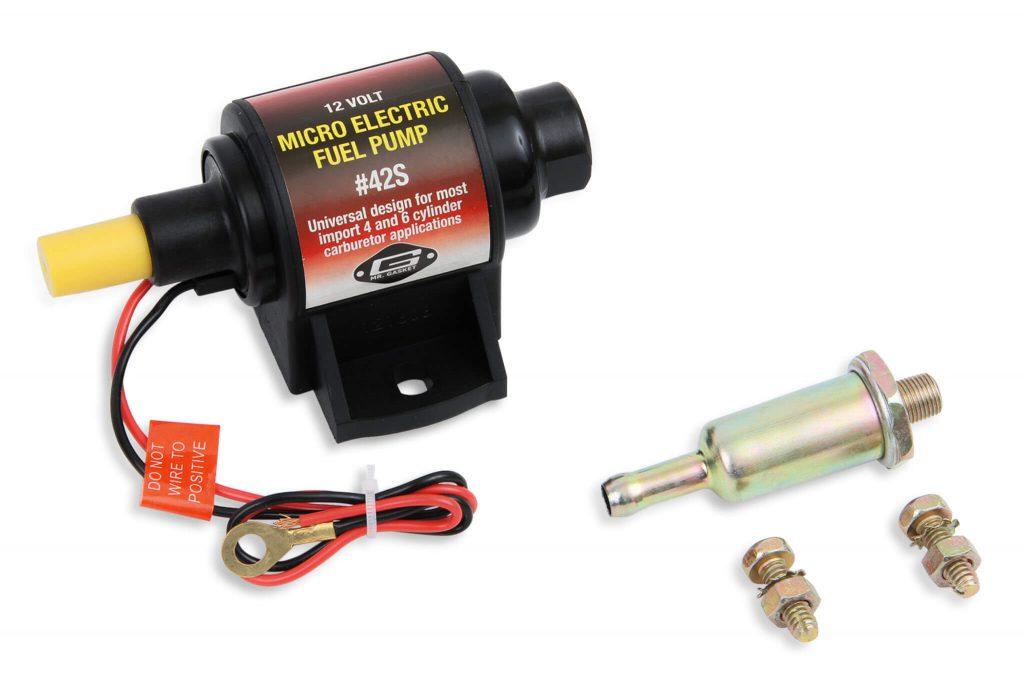
Furthermore, since they do not require a mechanical connection, these units are more portable and easier to use: they can be placed anywhere flexibly. Manufacturers most often place electric fuel pumps inside the fuel tank.
The cost of using cutting-edge technology is higher, but these pumps are well worth the extra dollars as they offer added safety by minimizing the risk of explosion. The pump’s robust coating also serves to avoid damage.
In-Tank Electric Fuel Pump and Inline Fuel Pump
When a fuel pump is mounted outside the tank, it is an externally mounted or inline fuel pump. If it is placed inside the tank, it is an in-tank fuel pump.
In the past, electric pumps were placed inside the fuel tank. This helped reduce the risk of fire from extreme heat or a spark, as both gasoline and diesel are cold in liquid form and do not explode.
On the other hand, if you run out of fuel or take a sharp turn, the fuel flow in the pump can be interrupted, which can not only cause your vehicle’s engine to misfire but also damage the pump itself.
Technology has progressed and the inline fuel pump was developed, which can be safely mounted outside the fuel tank. Balance and stress sensors ensure that if the pump is clogged or damaged, or if the vehicle is involved in a collision, the pump stops, thus cutting off the fuel supply to the engine and killing it.
3. Manual Fuel Pumps
As the name implies, fuel is transferred from the fuel tank to the combustion chamber manually using hand pumps that, by turning, siphon fuel from one place to another.
This type of pump is particularly handy in case of power shortage, as the device does not require electricity and in the case where the car is equipped with a non-conventional fuel tank, such as jerry cans. The manual pump is the cheapest type.
Fuel pumps can also be classified into three types based on fuel flow rate:
1. Low Speed
This category includes pumps that can move 50 liters of fuel per minute from one point to another. These pumps are useful for transferring fuel in smaller vehicles as they minimize the risk of spillage.
2. Medium Speed
By transferring 70 liters per minute, these pumps serve at a moderate speed and are suitable for large trucks or vehicles with large tanks.
3. High Speed
By pumping 90 liters per minute, these pumps do the job quickly and efficiently and are therefore highly recommended for rigorous work. Heavy machinery will get the most out of these powerful pumps.
The Best Fuel Pump: Buying Guide
Choosing the best fuel pump most suited to your vehicle and engine requires thorough research, as there are many purchasing criteria, from flow rate to pressure to compatibility, all of which are important.
Consider the following purchasing factors to decide which is the best fuel pump that offers the right balance between different requirements.
Power
Your engine’s power determines the fuel flow rate needed to run it. As power increases, the volume of fuel needed to run it also increases.
A good indicator of the volume/power ratio is about 10 hp per gallon or 2.64 hp per liter. For example, if your pump flows at 60 gph, it should be able to support a 600 hp engine. However, to actually know the gph, you must also take into account the fuel pressure required for your engine.
Fuel Pressure
Fuel pressure is also an important element in fuel management. Fuel pressure is rated at one gallon per hour and one liter per hour at different psi.
Different engines require different fuel pressures. For example, a carbureted engine typically requires between 4 and 7 psi, while a General Motors small-block V8 LS engine runs at about 58 psi.
It is important to know the maximum pressure required by your engine, as fuel pressure has a significant effect on the flow that a pump can produce. A fuel pump will flow at its highest volume when there is no pressure, or “free flow.” When fuel pressure increases, fuel flow decreases.
Each pump has a different flow rate at a given pressure. That’s why it’s important to examine the flow chart of the pump you decide to buy.
It should also be noted that different types of fuel will produce a different type of fuel pressure. Sometimes, certain fuel pumps can only handle one specific type of fuel.
In this case, they may work with non-designated fuel types but will deteriorate very quickly. Using an incompatible fuel type will create suboptimal fuel pressure, thereby reducing the fuel pump’s durability.
Note:
Fuel pressure determines the use of different types of filters and accessories for better performance. Additionally, electric pump installation locations depend on fuel pressure.
Voltage
Fuel pumps have different flow rates depending on voltage. When voltage increases, the fuel pump speed also increases, which increases the flow rate at a given pressure.
Therefore, when looking for the best fuel pump for your vehicle, it is advisable to check the pump’s rating at a given voltage. Most cars produce about 13.5 volts when running.
Fuel Type
Although most pumps are capable of working with different types of fuels, some are not. So it’s best to check if the fuel pump you are considering works with the type of fuel consumed by your vehicle.
Fuel Pump Locations
Depending on the fuel pump installation location, the pump can vary. Most mechanical pumps are mounted on the engine and placed outside the fuel tank. Electric fuel pumps can be mounted inside the tank or outside.
Materials Used / Durability
Even if you don’t necessarily need a heavy-duty fuel pump for your vehicle, durability is always a crucial factor. A durable fuel pump will save you a lot of time and money on maintenance and offer you better value for money.
Materials that claim to meet the “OE standard” will result in a longer lifespan.
The warranty will be another indicator of a fuel pump’s quality and durability. In general, you can expect that the longer a product’s warranty, the more confident the manufacturer is in its products, or the higher their quality and durability.
Nowadays, a good number of products offer replacement and repair warranties for varying durations.
AC/DC – Alternating Current/Direct Current
DC products are often portable and easier to use.
Purpose
You might be buying a fuel pump for heavy machinery while others are buying it for their daily commute.
If that’s the case, there’s no need to get an unnecessarily powerful fuel pump, even if it’s considered the best fuel pump. That would be overkill and would surely cost you more.
Best Fuel Pump 2024: Mechanical Fuel Pump
Airtex 40987 Fuel Pump – $15.50

Highlights
- Materials comply with OEM standards
- Requires only one gasket
- Heat treatment and more durable performance
- Adapts to multi-blend fuels
Disadvantages
- Has only one inlet and outlet
- May not be compatible with older vehicle models
For only less than $20, this mechanical fuel pump can provide from 7.5 to 9 psi per minute with a single gasket. Furthermore, the hardened shafts and rocker arms are modified to offer better performance. They are heat treated for an extended lifespan.