
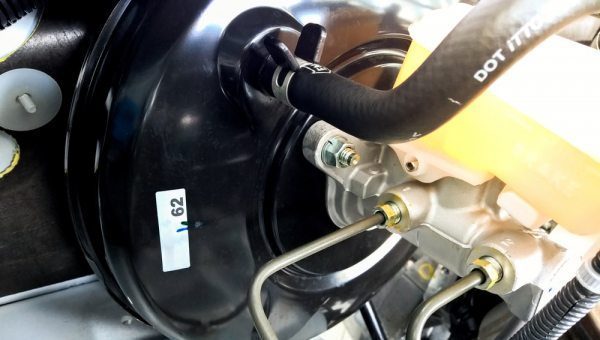

A brake booster can be found in most modern vehicles.
When you press the brake pedal, you don’t need to apply too much pressure to brake the vehicle. This is due to the brake booster, which amplifies the pressure you apply and helps to stop the car comfortably.
Brake boosters are also called “servos,” and they not only increase the car’s safety but also help improve performance. Like any other component of a car, the brake booster can be damaged after some time, which can cause problems when stopping the car.
In this article, we will discuss the most common symptoms you will encounter with a faulty brake booster and how you can replace it.
Purpose of the Brake Booster
In the past, vehicles were equipped with drum brakes that used their own electrical assistance. After that, they were replaced by disc brakes, but drivers still had difficulty applying enough pressure to stop the car. Therefore, modern vehicles were equipped with a brake booster.
The main task of the brake booster is to reduce the driver’s effort when braking. The brake booster, located between the brake pedal and the master cylinder, uses a vacuum to overcome the pressure of the fluid in the braking system.
Signs of a Bad Brake Booster
Below are the most important symptoms you should notice if your brake booster is threatening to fail or has failed.
1. Difficulty Pushing the Brake Pedal
The first most common symptom you will notice is that the brake pedal is hard to use. Additionally, sometimes the brake pedal doesn’t even return to its original position and may stick to the floor. If you notice something like this, it means something is wrong with the brake booster. Since it is not safe to drive with faulty brakes, we recommend replacing the brake booster as soon as possible.
2. Brake Pedals Become Higher Than Usual
Furthermore, the brake pedal may be stiffer than average, so if you notice it is slightly higher than usual, it means there is a problem with the brake booster. Such a situation can be dangerous and should be corrected immediately to avoid an accident.
3. The Car Takes Longer to Stop
If the brake booster is faulty, the pedal does not receive enough force to stop the car immediately. So, if your brake booster starts to fail, the car will take longer to stop. In slippery weather, this can be dangerous, so we recommend taking your car to a professional mechanic and having the braking system checked.
4. Engine Stalling
A faulty or defective brake booster draws extra vacuum from the engine. This happens when the brake booster’s diaphragm fails, allowing air to escape through the seal. As a result, whenever the brake pedal is pressed, the engine stalls a bit. This problem can even damage your engine and lead to more expensive repairs.
5. Hissing Heard Under the Dashboard
A faulty brake booster sometimes produces a hissing sound that can be heard under the dashboard. The noise is caused by vacuum escaping, and this vacuum loss can also lead to performance issues. To avoid further damage to the brakes or engine, it is recommended to repair the brake booster promptly.
How to Test the Brake Booster?
Brake Pedal
Before going to a mechanic to replace the brake booster, it is advisable to check it yourself by following the procedure below.
Step 1: Start the Engine
Start by sitting in the car and putting the gear in neutral for a manual car or in park for an automatic car. Start the engine with the handbrake engaged, let it idle for a while, then turn it off.
Step 2: Press the Brake
Start pumping the brake pedal, usually about four times, and hold the pedal down with light pressure.
Step 3: Start the Engine
Start the engine with your foot on the pedal, and you will notice that the brake pedal sinks slightly. If it doesn’t, then the brake booster likely lacks sufficient vacuum.
Step 4: Turn Off the Engine
Gently lift your foot off the brake and turn off the ignition.
Step 5: Press the Brake Pedal Again
Pump your foot on the brake pedal about four times. If you feel the pedal lift after the second or third time you press it, it is possible that the brake booster is holding a vacuum or there is a vacuum leak in the brake booster. You can use a vacuum gauge or a vacuum pump to find out exactly where the problem is occurring.
Step 6: Hold the Pedal
Start the engine, then press the brake pedal and turn the key to stop the engine. Hold the pedal down for 30 seconds after turning off the engine and check if the pedal stays in that position after releasing it. If it does not stay in that position, there may be a leak in the brake booster, the vacuum hose, or the engine vacuum.