


More and more new cars are equipped with advanced driver assistance systems (ADAS). Some of the most common include:
- Forward collision warning
- Automatic emergency braking
- Adaptive cruise control
- Lane departure warning
- Lane keeping assist
- Blind spot monitoring
- Rear cross traffic alert
- Parking assist/self-parking
- Adaptive headlights that steer with the vehicle
- Automatic high beam headlight activation and dimming
To do their job, ADAS rely on inputs from a variety of sensors that allow the systems to “see” what is happening around the automobile. The most common are cameras, radars, and ultrasonic sensors. Steering sensors are also used to help determine the vehicle’s direction of travel. Some systems use information from a single type of sensor, but others combine information from multiple sensors – a process called sensor fusion – to get a more accurate “view” of the situation.
Most ADAS sensors are very precisely targeted and require calibration if their positions are disturbed in any way. Consider that a sensor on the car that is misaligned by a fraction of an inch or even one degree will be aimed at a significantly off-axis area 50 feet or more down the road. Misaligned sensors often result from collisions – even a small fender bender can misalign ADAS sensors. However, calibration may also be necessary as a byproduct of routine maintenance work such as windshield replacement, suspension repair, or wheel alignment.
Failure to calibrate a sensor when needed can result in erroneous information that will cause the ADAS to operate incorrectly or not at all. A faulty sensor input can result in:
- A warning light or message on the dashboard
- A diagnostic trouble code (DTC) stored in the vehicle’s computer memory
- Steering wheel vibration
- Vehicle steering pull
- Increased steering effort
Issues like these can cause a driver to lose confidence in a car’s ability to provide safe transportation. ADAS failures can also raise questions about the quality of an auto repair shop’s work.
The most common types of ADAS sensors are cameras, radars, ultrasonic emitters, and steering angle sensors. Here is more information on each.
Many vehicles are equipped with forward-facing camera sensors. These sensors are commonly used for automatic emergency braking, adaptive cruise control, lane departure warning, lane keeping assist, and automatic high beam headlight activation and dimming.
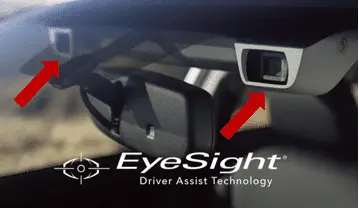
Because cameras are optical devices that must be able to “see” the road, it is generally easy to identify when a car is equipped with this type of sensor. Many camera sensors mount against the inside of the windshield as part of an assembly integrated with the rearview mirror; others attach to the interior of the roof, either directly or as part of a mirror housing. Some automakers, including Subaru and Land Rover, use two cameras spaced apart from each other to improve depth perception.
The high-definition image receivers used in camera sensors are not so different from those found in other digital camera applications. What makes ADAS camera sensors unique are the high-power microprocessors and advanced data processing algorithms that are built into the assembly. These components transform the constantly changing analog image that the camera sees into digital information that ADAS can use to control various safety-critical systems.
Camera sensors “see” the world through the windshield and are designed for specific rates of light transmission through glass that has minimal imperfections and distortion. A problem in any of these areas can interfere with a sensor’s ability to provide accurate information. For this reason, many automakers specify that only an original equipment manufacturer (OEM) windshield should be used if replacement is necessary on a car with a camera sensor. In fact, some car dealerships will refuse to calibrate a camera sensor on a car where an aftermarket windshield is installed.
Some newer cars are equipped with 360-degree surround view camera systems that use multiple small cameras at the front, rear, and sides of the vehicle to display a bird’s-eye view of the immediate area around the vehicle. These are simpler, lower-resolution cameras than those used for ADAS, although they also require calibration. The cameras are typically located in the bumpers or front grille, under the side mirrors, and in the trunk lid or tailgate. The computer controlling the system “stitches” the multiple images together to provide a seamless overall view displayed on the infotainment screen in the dashboard.
Adaptive cruise control, forward collision warning, and automatic emergency braking are the ADAS most commonly associated with forward-facing radar sensors. The millimeter-wave radar sensors used on vehicles transmit a high-frequency radio signal that reflects off objects and returns to the sensor. The time it takes to receive a return signal is used to calculate the car’s distance to an object.
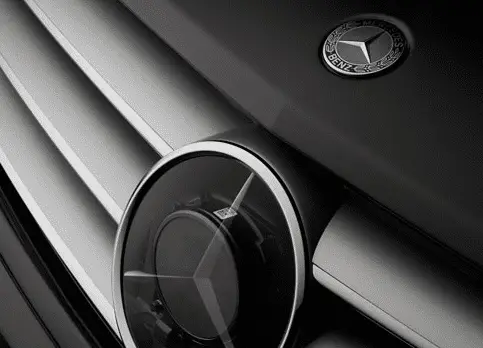
Radar sensors are typically mounted in or behind the front bumper or grille. In a few cases, the radar sensor is mounted in the front camera housing in front of the rearview mirror. Radio waves can pass through glass and plastic bumper covers or grille materials, and the sensor usually has a cover to protect it from stones and other road debris. While many radar sensors are center-mounted, others are offset to one side of the automobile, which affects the calibration process.
Because they are sometimes hidden, determining if a vehicle is equipped with a radar sensor can be more difficult than identifying the presence of a camera sensor. If an external visual inspection does not indicate the presence of a sensor, opening the hood might reveal one. Another method is to check for adaptive cruise control switches inside the car (usually on the steering wheel) or a warning light for an automatic emergency braking and/or adaptive cruise control system that illuminates on the dashboard as a test when the car is first started.
Some rear collision warning and blind spot monitoring systems use small radar sensors mounted under the side mirrors, behind the rear bumper cover, or even in the taillights. Sensors mounted on bumpers and taillights can also provide rear cross traffic alerts when backing out of parking spaces.
To avoid potential interference, most automakers do not allow repairs on the areas of bumper covers that are in front of radar sensors. They also recommend using only OEM covers to ensure that the materials used will not interfere with the sensor signals. Excessive thickness of bumper cover paint can also be an issue on some vehicles, and automakers advise against placing bumper stickers anywhere near radar sensors.
Ultrasonic sensors are primarily used for parking assist and self-parking systems. These sensors are installed in the front and/or rear bumper covers where they use reflected high-frequency sound waves (in a manner similar to radar) to detect people, cars, and other objects near the vehicle. Sensors of this type on the sides of cars are used in some self-parking systems and can serve as additional sensors in blind spot monitoring systems.
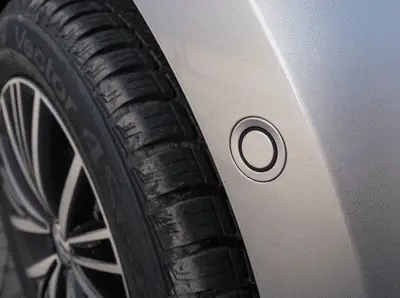
ADAS ultrasonic sensors do not require calibration. However, they are designed to be in very precise positions in the bumper cover, or anywhere else they are mounted. For this reason, some automakers do not approve the use of aftermarket, remanufactured, or recycled body parts, which may be warped or lack pre-drilled holes in the appropriate locations for sensor mounting. Although most ultrasonic sensors broadcast a symmetrical circular sound pattern, some generate an asymmetrical oval pattern that requires them to be mounted with a specific orientation to function correctly.
Steering angle sensors are used in lane departure warning, lane keeping, and adaptive headlight ADAS. The information they provide is also used for other safety and performance-related systems, such as electronic stability control and adaptive suspensions. These sensors are typically integrated into the steering column and measure the degree of rotation of the steering wheel.
ADAS sensor calibration is required whenever a sensor’s aim is disturbed in any way. This can occur during a collision, even a slight fender bender, or be a byproduct of routine maintenance work such as windshield replacement, suspension repairs, or wheel alignment. Calibration is also necessary whenever a sensor or its mounting bracket is removed and replaced, there is a tire size change, a front airbag deploys and deflects off the windshield, or repairs are made to a car roof on which a sensor mount is located. Finally, sensor calibration is necessary when there is an associated DTC in the car’s computer memory or an automaker issues a technical service bulletin with instructions for calibration to be performed as part of another repair.
Replacing and calibrating sensors is often part of collision repairs. Automakers recommend that body shops now perform a full diagnostic scan on each vehicle before repairs begin, and then again once the work is completed. This will help the body shop better understand the extent of any issues before work begins, and then confirm that all issues have been resolved, ADAS sensor calibrations are complete, and the vehicle’s control systems are communicating correctly before the car is returned to the customer.
ADAS sensor calibration is a precision process that is often complex and time-consuming. Some sensors can be calibrated in a repair shop, others require a vehicle to be driven, and many sensors require both procedures. The time required can range from 15 minutes to an hour or more, depending on specific calibration requirements. When necessary, this additional labor adds to the cost of repairs.
Due to the challenges involved, many auto repair shops and windshield installers currently send cars to the dealership when ADAS sensor calibration is required. Independent service providers who wish to perform sensor calibrations must invest considerably in these necessary tools:
- Service information that describes the equipment and procedures needed to calibrate ADAS sensors on a given vehicle year, make, and model. This information may be available on the aftermarket, but sometimes must be obtained from the automaker. ADAS sensor calibration requirements can be determined by performing an OEM Calibration Requirements Lookup or by using links to OEM Service Information. Both options incur a cost for the maintenance shop.
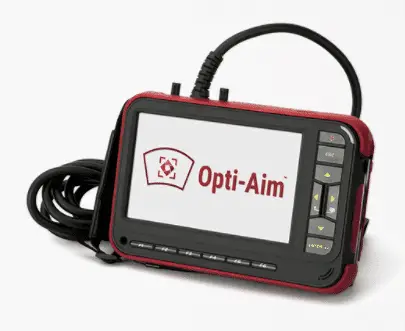
- A car computer scan tool that supports ADAS sensor calibration. Factory scan tools can handle the necessary operations for all vehicles and sensors of a specific automaker. The capabilities of aftermarket scan tools vary widely, but some devices will work with certain vehicles and sensors from a number of different automakers. Special tools designed exclusively for ADAS sensor alignment are also available, but as with aftermarket scan tools, the extent of vehicle coverage varies.
- A large, flat, paved indoor area with non-glare lighting and a background free of clutter (camera sensors) and metal objects (radar sensors) that can interfere with calibration. Honda, for example, specifies an open area 13 feet wide, 5 feet high, and extending at least 23 feet in front of the car. The Lexus radar calibration process (performed outdoors) requires a large open road at least 32 feet long and 45 feet wide in front of the car.
- A wheel alignment rack. Many automakers require or recommend that a four-wheel alignment be performed before ADAS sensor calibration. This ensures that the vehicle’s thrust line, an imaginary centerline drawn lengthwise through the car, points straight down the road when the steering wheel is centered. ADAS sensors are then calibrated to align with the thrust line. Wheel alignment equipment is now available with built-in ADAS calibration capabilities, although a static and/or dynamic aiming process (see below) may still be required.
Before calibrating an ADAS sensor, a vehicle must be prepared as specified by the automaker. Some of the common requirements include:
There are two forms of ADAS calibration, static and dynamic. General descriptions of these processes are provided below, but the exact procedures vary considerably from one vehicle make and model to another. In all cases, the procedures and instructions specified by the automaker must be followed to the letter.
Static sensor calibration begins by establishing the vehicle’s thrust line. Automakers specify a variety of manual measurement methods and special tools to perform this part of the process. In many cases, the tools attach to or are aligned with the front and rear wheel hubs. Laser projectors are often built into the tools to ensure perfect alignment.
Next, one or more special aiming targets are positioned at precise locations relative to the thrust line and the sensor. The targets must be at a specified height, and many are designed to be used with special adjustable mounting stands. When a sensor is offset from the car’s centerline, the targets must also be offset accordingly. While at least one vehicle uses a target that is placed on