
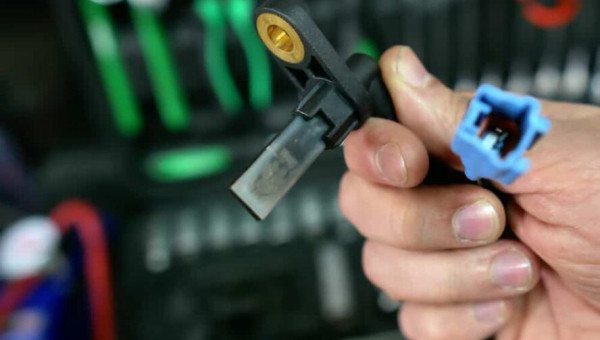

Driving a car is not just about speed; braking is also an important aspect. And when it comes to braking, your car’s ABS brakes are the hero.
The anti-lock braking system is widely used in vehicles today and it helps you slow down your car without locking the wheels. This results in fewer accidents and quicker stops.
However, ABS brakes operate under a system where ABS sensors send information to the car’s computer, and the computer makes the decision to activate the ABS function.
These special sensors are located near the wheels and consist of two vital parts: the tone ring and the magnetic sensor. These two pieces work together to ensure the effective functionality of the ABS. However, these components are exposed to wear and over time, their performance may deteriorate.
If any of these components fail, you could have major problems, but fortunately for you, there are ways to detect their failure. Every car is different, so some symptoms may appear in your car while they won’t in others. Check out the symptoms of ABS sensor failure below and expand your knowledge.
Signs of a Bad ABS Sensor
ABS Sensor
All the symptoms will do is help you diagnose an ABS sensor failure. At the end of the day, you will need to find a solution yourself or schedule a visit to the nearest workshop.
1. The ABS Light Turns On
This is the most common symptom of ABS sensors. When there is the slightest problem with the ABS sensor, your car’s onboard computer detects the malfunction and turns on the ABS light.
This light is similar to the check engine light that comes on in your car’s dashboard in case of engine failure. Naturally, if this light flashes, you should consider visiting your mechanic as soon as possible or reading the fault codes at home. The longer you prolong the ABS sensor problem
2. The Vehicle Takes Longer to Stop
The ABS system is put in place to help stop your car faster. It only comes into play when you press the brakes hard enough. Therefore, any fault in the ABS sensor will not activate the ABS system in time, and you will find that your car takes longer to stop than usual. You may also feel your car skidding and losing traction when you brake hard.
3. Pumping Brake Pedal When Braking
If an ABS sensor sends a faulty signal, you may feel a pumping in the brake pedal when braking. This is because the sensor makes the brake control unit think the car is skidding, but in reality, it is not.
4. Vulnerability on Wet Roads
ABS sensors transmit valuable information to the ABS system, which allows it to maintain your car’s stability and traction on less grippy surfaces. Wet and icy roads are the biggest enemy of your brakes, and your ABS system is probably the only shield against loss of traction other than using winter tires.
Therefore, if you feel that you are losing control when braking on wet roads, it indicates that your car’s ABS sensors are not in optimal condition. However, it could be that the module is not working properly. To find out, you will need to visit a mechanic and request an inspection.
What is an ABS Sensor?
The main function of the ABS speed sensor is to monitor, record, and transmit information about how the tires are rotating. If there is a slip between your vehicle’s wheels, the ABS sensor would quickly alert the ABS system. The message is generated from the difference detected by the ABS sensor and is transmitted to the ABS computer. As a result, the ABS would engage and override your vehicle’s manual braking.
Basically, the ABS speed sensor consists of a magnetic sensor that performs the main function. According to the principle of induction, when the slots of the tone ring pass through the magnetic lines of force inside the magnetic sensor present in the ABS sensor, a voltage is induced. This voltage then generates a signal for the ABS control system. Although this is the most common principle, in some vehicles, the design may use a different approach. Usually, such a sensor is mounted on anything that has a rotating body. It is essentially a safety anti-skid braking system.
Where Are the ABS Sensors Located?
Typically, in most modern vehicles, the common design requires ABS speed sensors to be mounted near the wheels. Technically, this is the most appropriate place to mount the ABS speed sensors on your vehicle. There may be an exception in some vehicles, such as trucks with solid axles.
Replacing a Faulty ABS Sensor
If the ABS sensor is not working properly in terms of monitoring the timing between the wheel and the brakes, it must be replaced with a new one. If you wish to perform the replacement yourself, here is a brief step-by-step guide on how you can proceed to replace your vehicle’s ABS sensor. Replacement instructions may vary greatly from one car model to another. This is a general guide.
Make sure you have all the necessary equipment with you.
Refer to your vehicle’s maintenance manual to locate and identify the sensor.
Through the diagnostic procedure, identify the sensors that have failed and need to be replaced. This is usually done by testing each sensor individually.
Remove any obstacles to access the sensor.
Remove all electrical connections and wiring from the sensor.
Remove the sensor by disassembling it from the wheel.
Be sure to keep a record of the wiring and the places from which you disconnected the wires.
Thoroughly clean the tone ring and the sensor mounting hole to remove accumulated dust or brake dust particles.
Match the old sensor with the new one
Install the new sensor in the place where you removed the old one by inserting it into the mounting hole.
Be gentle to avoid breaking it.
Reconnect the connectors to the correct places and route the sensor wires along the correct path.
Secure the sensor connections to the vehicle.
Clear the error code from your vehicle’s scan tool.
Take a test drive to ensure everything is working properly.
Diagnosing a Bad ABS Sensor
Diagnosis is important for the ABS sensor because it will help us understand exactly where the problem lies. Here is a brief procedure that can help you diagnose a faulty or defective ABS sensor.
Park your vehicle on a flat surface.
Keep the engine off.
Acquire the necessary tools and your vehicle’s maintenance manual.
Locate the ABS sensor.
Find all electrical connectors and wires. Remove them one by one.
Use the voltmeter and gently attach the probes to the sensor.
After attaching the switch, set the voltmeter to alternating voltage.
Allow the voltage to fluctuate, then drop to zero.
Once it is at zero, perform the test by spinning or rotating the hub or axle.
Due to the rotation, a voltage should be produced and readings will appear on the meter.
If the readings do not appear and remain at zero, the ABS sensor is faulty and must be replaced with another.
Once you know the problem, it is wise to start thinking about solving it. However, troubleshooting ABS-related issues is not everyone’s cup of tea, so you may not be able to do much. Here is a list of things you can do to fix your ABS sensor failure.
Read the Fault Codes
While an OBDII scanner is typically used to diagnose problems related to the ECU, some OBDII scanners available on the market can also diagnose ABS sensor problems. Invest in such a scanner wisely, as they cost a lot of money but are extremely useful. When you connect one to your car, it will show you a particular code on its screen indicating where the problem lies. Sometimes, simply resetting the error code sent by the ABS system can solve the problem; however, if the problem persists, you can consult your nearest mechanic for a quick solution. You can check out our article Best OBD2 Scanners to find a scanner that suits you.
Clean Your Wheel Arch
The ABS sensor(s) is/are located near the wheel where the rest of the suspension is. Most of the time, a sensor may stop responding if dirt accumulates nearby. You can use a blower to clean the dirt from your suspension and wheels, or you can go to a service station, pay a few dollars, and have your car cleaned from underneath with a pressure hose. If you’re lucky, your car’s ABS light will turn off.
However, if even after trying everything, you still have no luck, it’s time to visit a seasoned mechanic. Mechanics are car doctors, and as such, they charge exorbitant rates for their services. But when you have no choice, you have to spend money.