
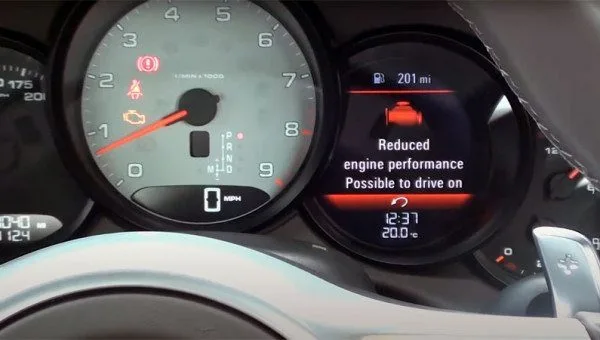
Imagine this: you’re driving as you would on any normal day. Suddenly,
your dashboard lights up like a Christmas tree. Your car is still running, but it has barely any power.
What just happened, you ask? Your car has likely entered limp mode.
What is Limp Mode?
Limp Mode (also called Limp Home Mode) is a very conservative calibration or map used by your Engine Control Unit (ECU) or Transmission Control Unit (TCU) when a potentially dangerous fault is detected in one of the powertrain components.
You can think of limp home mode as a safe mode for your car designed to prevent or mitigate engine damage. Instead of completely shutting down the engine and leaving you stranded, this calibration allows the driver to cautiously “limp home” or get to a mechanic for diagnosis and repair.
When a vehicle is running in limp mode, it may do several things that reduce the vehicle’s available performance to a safer level.
limp home mode causes
First, most engine calibrations tend to be rich, as a rich air-fuel mixture is often much safer than a lean air-fuel ratio. An ECU in limp mode may also limit the engine’s maximum speed (RPM), pull ignition timing (delay when each cylinder’s spark occurs), or alter valve timing (change when the intake and/or exhaust valves open).
If your vehicle is turbocharged, the map will likely run with the turbo’s wastegate fully open, which will limit boost pressure to its mechanical minimum. This boost pressure is likely an order of magnitude lower than the maximum boost pressure you would normally see.
If the fault was detected in the transmission, your transmission may shift into second or third gear and stay there. This will result in slow acceleration from a stop and a much higher engine speed on the highway.
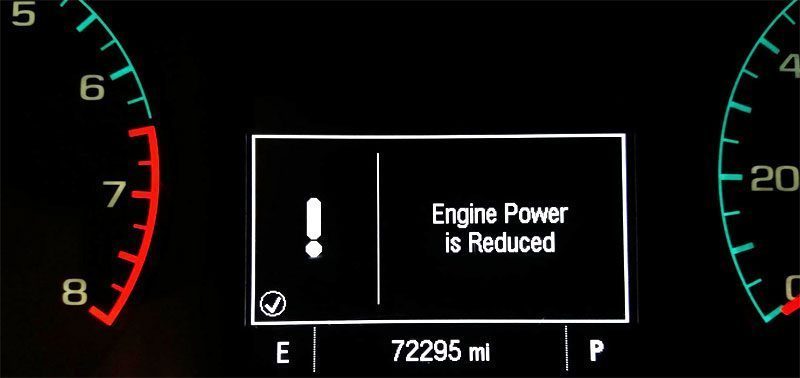 What Causes Limp Mode?
There are several causes of limp mode. Some causes are vehicle-specific, as each manufacturer’s ECU and TCU implementation is a bit different.
#1 – Faulty Sensor(s)
Sometimes a vehicle enters limp mode when the ECU is confused, either due to a faulty sensor, a missing sensor signal, or a sensor reading out of specifications.
If the engine has no way to accurately read the density of the air entering the combustion chamber, it won’t know how much fuel to inject. Injecting the wrong amount of fuel for the given situation can damage the engine, especially when engine RPM and load increase.
#2 – Overboost
limp mode turbo engine
On a turbocharged vehicle, the boost controller controls the operation of the wastegate. A wastegate normally allows excess exhaust to flow around the turbocharger (rather than through the turbo’s exhaust turbine). This is done to maintain target boost pressures.
Overboost is a condition when the actual boost pressure is much higher than the ECU’s target boost pressure for a prolonged period of time. If a turbocharged vehicle enters an overboost condition due to a failure of the boost controller or the wastegate solenoid, it may trigger limp mode to prevent catastrophic engine damage, such as spun bearings, broken piston rings, or bent connecting rods.
Overboost due to a wastegate that simply cannot flow a sufficiently high volume of exhaust is called boost creep, and sometimes manifests at higher RPMs on modified vehicles. Boost creep is more likely to appear in cold weather near sea level when the air is very dense. This is a mechanical issue that cannot be solved by recalibrating the ECU.
#3 – Knock or Misfire
Constant engine misfires or knock can eventually put a vehicle into limp mode. One or two misfires probably won’t trigger limp mode, and you’re unlikely to have issues with intermittent knock that occurs during highway cruising.
Almost all engines knock at some point, but in mild cases, the ECU will often pull ignition timing for a little while until things return to normal.
#4 – Vacuum or Boost Leak
vacuum hoses
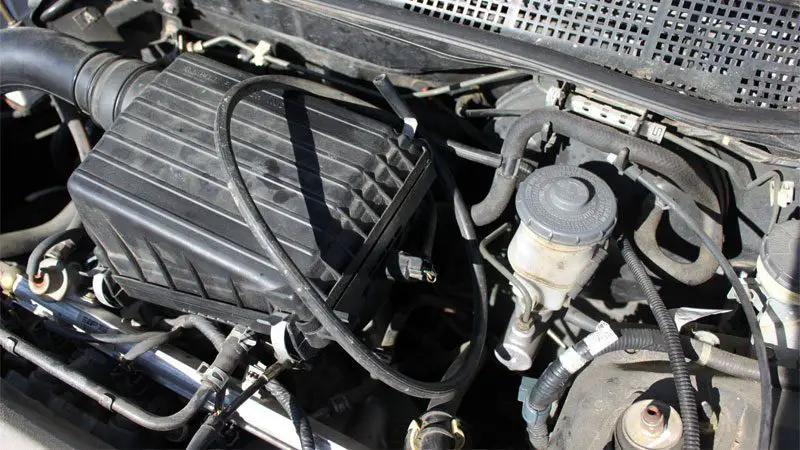
A significant vacuum or boost leak often introduces a large volume of unmeasured air into the combustion chamber, which significantly alters the air-fuel ratio. If the actual air-fuel ratio differs significantly from the expected air-fuel ratio, a vehicle may enter limp mode.
#5 – Low on Fluid
Some ECUs and TCUs monitor fluid levels. If the engine oil or transmission fluid level is very low, it can cause oil pressure to drop, which could trigger limp mode in some vehicles.
#6 – Missing Emissions Equipment
symptoms of a bad catalytic converter
Modifying a vehicle to remove pollution control equipment will often trigger limp mode due to a missing sensor or other component (furthermore, this practice is also illegal in many places).
#7 – Overheating
If your vehicle is overheating, the ECU may cut fuel to some cylinders to allow fresh air to reduce engine temperatures.
How to Bypass Limp Mode
how to bypass limp mode
Bypassing limp mode is generally not recommended unless you have a very good reason to do so and understand the potential consequences. Something was not right with the vehicle when limp mode was triggered, and if you try to continue driving the vehicle using normal engine or transmission settings, you risk damaging the powertrain.
The following tips are very temporary fixes that can be used to get you home or to the shop, but will not solve the root cause of the problem. Please take your vehicle to a mechanic for diagnosis and repair of the actual issue as soon as possible to avoid the very real possibility of engine or transmission damage.
If any of the following tricks work, you can expect limp mode to return fairly quickly if the problem persists. Try to drive with this in mind, positioning yourself in a lane with a shoulder or taking less busy roads.
#1 – Restart the Car
Sometimes simply turning the car off and back on will exit limp mode.
#2 – Clear the Code
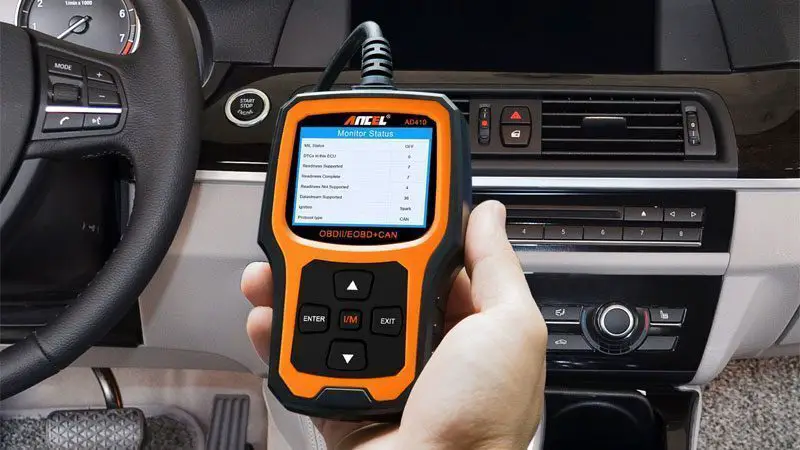
You may be able to clear any codes you find using an OBD2 scanner. It’s best to just buy a good OBD2 scanner as it can pay for itself after just one use, but your local auto parts store will likely have scanners you can borrow. Unfortunately, they may not be allowed to clear the code on your behalf for liability reasons.
#3 – Disconnect and Reconnect the Battery
Many vehicles will forget a thrown check engine light after the battery has been disconnected and then reconnected. Simply disconnect the negative battery terminal and reconnect it after a few seconds.
You may want to hold the brake pedal down for a moment while the battery is disconnected to ensure any remaining electricity in the system has dissipated.