
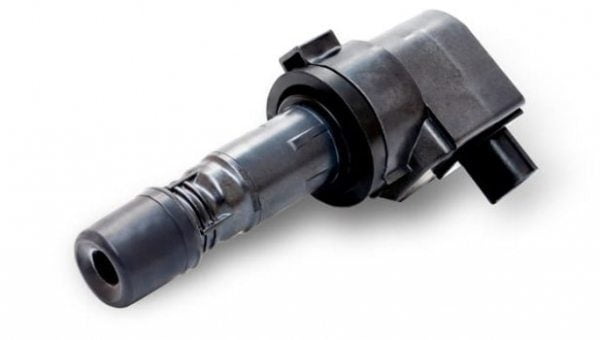

With broken ignition coils, your car won’t go anywhere. Check out our guide to keep your car on the road.
When it comes to ignition system parts, ignition coils are by far the most important. Without an ignition coil, the entire ignition system wouldn’t work. But it seems that spark plugs get all the credit. People know and regularly change their spark plugs, and spark plug brands like Champion and NGK regularly sponsor everything from F1 to rally, but when it comes to ignition coils, people don’t exactly know how they work or what they do.
The truth, however, is that ignition coils are vital to the ignition system and can cause serious problems if they go wrong. They could also be the cause of some of the common ignition problems that drivers face daily.
Read on to discover our complete guide on what ignition coils are, what they do, and how to spot when your coils aren’t working as they should.
WHAT ARE IGNITION COILS?
The purpose of ignition coils is to amplify the battery voltage so that a spark plug can ignite the engine’s air-fuel mixture. A fully charged car battery has a voltage of about 12.6 V, but several thousand are needed to produce the spark that jumps the gap.
An ignition coil is normally made up of two sets of coils, a primary and a secondary, around an iron core and in a metal housing. This one is then linked to the distributor and then to the spark plugs. The output (called low voltage current) comes from the battery and is transformed by the coil into up to 45,000 volts (called high voltage current) before reaching the spark plugs.
Some ignition systems use one coil to provide the spark to all cylinders, but most newer models use an individual coil for each cylinder.
In older cars, these will look like a small metal cylinder with wires coming out of it, one connecting it to the battery, the other to the distributor.
In modern cars, coils can be of all shapes and sizes, including a single coil that looks like a long plastic tube – also known as a pencil coil or plug well coil – one that incorporates an ignition module and another that looks like a plug you might find in your home.
You may also find coils arranged in series and called cassette or sequence coils, or coil rails.
HOW DO IGNITION COILS WORK?
An ignition coil is essentially a small “step-up” transformer. It relies on electromagnetism and induces a high voltage from a low voltage. The primary winding has relatively few turns of heavy copper wire and the secondary winding has thousands of turns of very fine copper wire. Both windings are wound around each other.
The primary winding is connected to the battery voltage and its ground can be turned on and off by the engine control unit (ECU). The secondary winding is connected to the spark plug. When the current is turned on, the primary wire receives the low voltage from the battery and generates a magnetic field around it.
However, the instant the flow is interrupted by the distributor or in more modern ignition systems, the electronic control unit (ECU), the magnetic field collapses, creating or inducing a higher voltage in the secondary wire that moves to the spark plug. The magnetic iron core allows electrical energy to pass between the two coils.
WHAT PROBLEMS CAN THERE BE?
Given the location of the ignition coils right above the engines, meaning they have to withstand the weight of the very hot combustion process in what is already a very hot engine compartment. An ignition coil always heats up, but normally, this doesn’t cause too much of a problem. For sensitive equipment parts like copper wiring, this is tough.
During the induction process, the coils alternately become hot and cold and are subjected to strong vibrations from the engine. This can cause the coil winding to break over time, as well as cracks in the insulation and housing.
The main reason for ignition coil failure, however, is due to voltage overload. This happens when the spark plugs are worn and the electrode gaps are outside the specified limits or in case of damaged wiring and wires.
Over time, the coil’s output voltage can reach damaging levels, causing short circuits when it burns through the insulation. The lifespan of an ignition coil is about 100,000 miles, so it should be a while before it causes you problems.
WHAT ARE THE SYMPTOMS OF IGNITION COIL PROBLEMS?
The symptoms are largely those associated with ignition system components. It is important to note that any one of these alone does not signal that there is a problem with the ignition coil, so it is important to check all parts of the ignition system to determine if it is the cause.
1. MISFIRING ENGINE, REDUCED POWER, AND ROUGH IDLE
Malfunctioning ignition coils will almost certainly cause performance problems for the engine. Since high voltage is needed for the spark plug to ignite the air-fuel mixture, if it’s not there, the car won’t start properly or the engine might misfire while driving. This can also mean that the car doesn’t accelerate as it should or that there is an overall loss of power, because the fuel doesn’t ignite. This will also lead to reduced fuel consumption.
2. CHECK ENGINE LIGHT COMES ON
This one is a clear symptom that something is wrong. Although it’s not the only reason why the dashboard’s check engine light might come on, if an ignition coil is faulty and not working as it should, the ECU will recognize it and turn on the Check Engine light. The computer may have detected that a coil is burnt out or short-circuited and needs to be replaced. If this happens, it’s best to take the car to a garage to have the ECU scanned and check the code to see if a faulty ignition coil is the culprit.
3. CAR IS NOT STARTING
A problem that surely won’t take you long to notice! This can really be due to a spark plug, the distributor, or a number of other factors, but a faulty ignition coil can also prevent the vehicle from starting. For cars that use a single ignition coil as the spark source for all cylinders, a faulty coil will affect the operation of the entire engine. If the coil fails completely, it means there will be no spark and therefore no engine.
For things like ignition coils, it’s best to have them checked at a garage to be sure that’s really the problem. Although spark plugs can be replaced relatively easily, coils are a bit more difficult to repair or replace, so it’s best to leave them to professionals.
HOW CAN I TEST MY IGNITION COILS TO SEE IF THEY ARE THE PROBLEM?
If your car has a distributor-based ignition system, all spark plugs will be affected, but if it’s a modern car with electronic ignition, only one plug might be, or two if they share the same coil. This can make it difficult to determine what the problem is.
Fortunately, for cars built after 1996, they will have an OBD II (On-Board Diagnostic) port with ignition misfire detection, and you can query it using a diagnostic tool, check for code P030X, X being the number of the cylinder that is faulty. This will let you know if the ignition coil is the problem or not.
Of course, a faulty cylinder can be caused by all sorts of ignition and fuel supply problems, not just a faulty coil. For this reason, you should remove and check the spark plug and, if there is a distributor, the HT cable.
Check the safety and integrity of the coil itself. Additionally, you can perform an ohm test of the ignition coil using a multimeter, which will check that the primary and secondary resistance of the coil meets specifications. This will be indicated in your car’s user manual.