
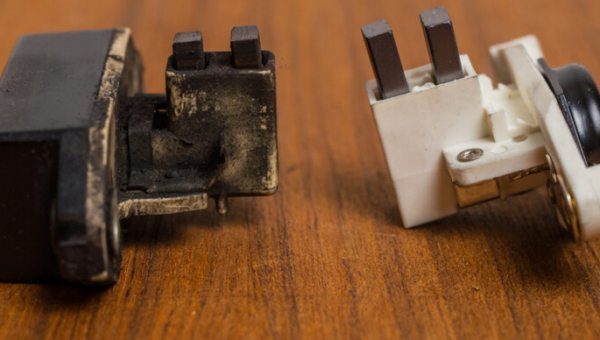

Your vehicle’s charging system contains tons of components. But while the battery and alternator get all the love, another crucial element is the voltage regulator.
But if you’ve never heard of a voltage regulator or don’t know how it works, you’re running in circles trying to figure out what’s wrong with your vehicle.
In this comprehensive guide, we’ll detail everything you need to know to check your voltage regulator and get your vehicle back on the road like new!
Symptoms of a Bad Voltage Regulator
Due to the importance of proper voltage in your vehicle, a voltage regulator can cause many different symptoms.
The most common symptoms of a bad voltage regulator are high voltage, dead car battery, check engine light, battery light, or dimming lights.
Below, we’ll highlight the six most common symptoms of a bad voltage regulator.
1. Overly High Voltage in the Battery
Measuring car battery voltage
A voltage regulator can fail in two ways. First, it can stop directing enough voltage to the battery. Second, it can direct too much power to the battery. If it sends too much power, you’ll run into problems as soon as possible.
A fully charged battery has 12.6 volts, but it’s not uncommon for it to sit at 13.7 volts while the alternator is charging it. Anything above that can cause damage. You’ll notice the battery getting much too hot, risking warping, and if left alone long enough, it could crack or explode.
2. Dead Battery
You’ll get too much voltage if the voltage regulator doesn’t divert power when it should. If it doesn’t send enough voltage to the battery, it will constantly be dead.
This can be one of the most frustrating components to troubleshoot because you typically don’t start looking at your voltage regulator when your vehicle isn’t starting as it should.
However, it’s quite easy to measure the alternator’s charging voltage with a multimeter.
3. Battery Light or Check Engine Light
Whether your voltage regulator fails to charge your battery or overcharges it, various sensors can trigger a check engine light or a battery light. If either of these lights comes on, you should immediately stop driving your car.
Either your vehicle could die completely, or the battery could overcharge and explode. Either way, nothing good will come of it.
4. Inconsistent Operation of Electrical Components
If your voltage regulator operates intermittently, the electrical components around your vehicle will also operate that way. Whether it’s your radio, dashboard lighting, or more critical components like your fuel pump, you’ll notice inconsistent operation.
If you have a lot of strange electrical issues, it might be that the voltage is too low or too high caused by the voltage regulator.
5. Vehicle Dies While Driving
If your voltage regulator doesn’t direct enough power to the battery while the engine is running, your vehicle will shut off while you’re driving on the road.
Your vehicle needs voltage to operate, so if there isn’t any, you’re going to have problems. This will usually only be an issue if the voltage regulator or alternator fails completely.
6. Dimming / Pulsating Lights
If your vehicle’s voltage regulator isn’t operating consistently, you might notice your lights flickering as they get brighter and weaker. This happens when your voltage regulator is unable to maintain a constant voltage as it’s supposed to.
However, if your voltage regulator starts to fail and doesn’t maintain the proper voltage, you might notice that you have lights that aren’t as bright as they should be.
Voltage Regulator Function
At the risk of sounding redundant, your voltage regulator regulates your voltage. If that doesn’t make sense, keep reading and we’ll explain exactly how it works.
All the voltage starts in your alternator, but since it’s belt-driven, it creates voltage whenever your engine is running. But your battery can only handle 14.5 volts at a time (12.6 volts is a full charge). If the alternator kept dumping all that voltage into the battery, it would explode!
Your voltage regulator monitors your battery’s current voltage and sends voltage that way when it starts to drop too low. When the battery has enough voltage, the regulator diverts all that excess power to ground, effectively removing it from the system.
When everything is working correctly, it’s an extremely efficient system that allows everything to operate as it should.
Voltage Regulator Location
Most of the time, the voltage regulator is located on the back of the alternator or inside the alternator.
However, some vehicles will have the voltage regulator mounted on the side of the alternator, but that’s quite rare.
If the voltage regulator is located inside the alternator, it can be difficult to locate depending on the type of alternator. While some manufacturers place them in easily accessible spots, others bury them.
Finally, many newer vehicles are starting to integrate the voltage regulator directly into the Engine Control Module (ECM). It operates on a separate circuit in these systems, and you cannot replace just the voltage regulator.