
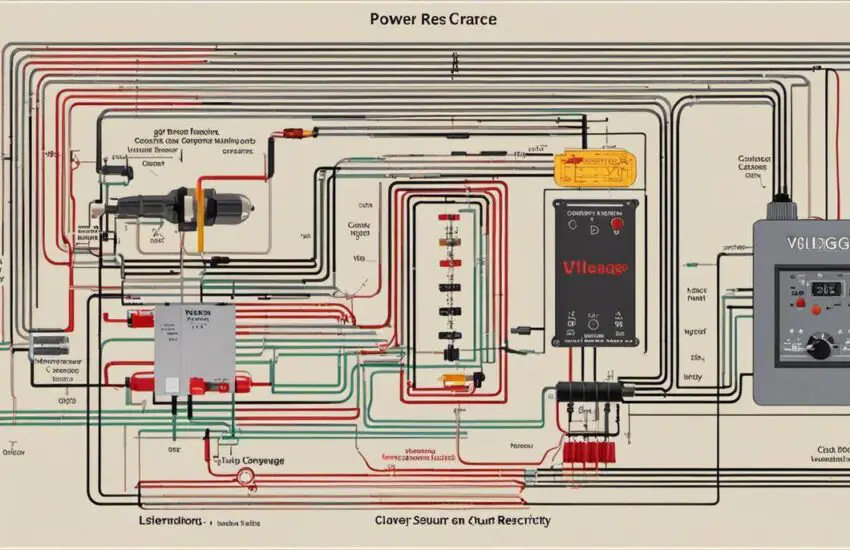
Mastering the basics of electricity and diagnosing electrical faults is essential for everyone today, given our increasing daily reliance on electricity. Understanding the fundamental concepts of voltage, current, and resistance can help us identify and solve electrical issues independently. Moreover, with in-depth knowledge of using various electrical diagnostic tools like multimeters, clamp meters, and voltage testers, one can quickly detect and correct electrical malfunctions. However, when handling these tools and electricity, it is crucial to adhere to safety standards to prevent potential accidents.
Understanding the Fundamentals of Electricity
Electricity, that invisible force powering our modern world, is a complex intrinsic scientific concept. Thanks to the continuous development of our knowledge in the field of electricity, we are now able to understand its fundamental principles to perform fault diagnostics accurately and effectively. This guide will provide an overview of these principles—current, resistance, voltage, electronic circuits, Ohm’s Law, and Kirchhoff’s Current Law—in as simple and accessible language as possible.
First, we have current, measured in amperes. It is the flow of electrons through a conductor. Also known as moving electricity, it can be imagined as the flow of water in a pipe.
Next is resistance, which is the property of a material to oppose the flow of electrons, i.e., the current. Measured in ohms, it is often represented by a series of restrictions in a pipe blocking the water flow.
Voltage, measured in volts, is the electrical force that pushes electrons through a circuit. It is often likened to the water pressure pushing water through pipes.
Now let’s talk about electronic circuits. A circuit is a closed path that allows current to flow. Circuits can be in series (where the current has only one path to follow) or in parallel (where the current can take multiple paths).
Next, Ohm’s Law, a fundamental law in electricity, states that the current in a circuit is directly proportional to the voltage and inversely proportional to the resistance (I=V/R). This principle greatly facilitates the diagnosis of electrical problems.
Finally, Kirchhoff’s Current Law, which states that the sum of currents entering a node (or a connection point in a circuit) is equal to the sum of currents leaving that same node. It is another indispensable tool for diagnosing electrical faults.
With a solid understanding of these fundamental principles of electricity, one can approach electrical fault diagnosis with confidence and precision. It undoubtedly requires some practice to master these concepts, but remember: electricity may seem mysterious and intangible, but it obeys very precise scientific laws that, once understood, can be used to solve a multitude of problems.

Learning to Use Electrical Diagnostic Tools
In the field of electricity, diagnostics are of paramount importance. Diagnostic tools play a crucial role in identifying and resolving issues related to electrical systems. Three of these tools are particularly important: the multimeter, the electrical network analyzer, and the oscilloscope.
A multimeter is perhaps the most common diagnostic tool in electricity. It is a multifunctional device that measures voltage, current, and resistance. To use it, one must connect the multimeter’s leads to the test points in the circuit to get a reading. It is crucial to set the multimeter correctly before use to avoid any potential damage to the multimeter or the circuit.
The electrical network analyzer is another essential diagnostic tool used to diagnose problems in an electrical network. It provides detailed information about the quality of the power supply, such as voltage fluctuations and current harmonics. Correct interpretation of this information can help locate a potential problem in the system.
Finally, an oscilloscope is probably the most complex diagnostic tool. It is used to visualize electrical signals as a function of time. The information obtained can be used to analyze circuit performance and detect problems. Its use requires some expertise and experience, as interpreting the displayed information can be tricky.
These three tools provide an effective method for diagnosing and solving electrical problems. However, it should be noted that their use requires a thorough knowledge of electrical theory. In particular, mastering the fundamental principles of electricity, such as Ohm’s Law and Kirchhoff’s Current Law, is essential to use these tools effectively.
In summary, while the multimeter, electrical network analyzer, and oscilloscope are essential diagnostic tools in electricity, their effective use is deeply rooted in a profound understanding of electrical principles and laws. This is a perfect illustration of how advances in electricity depend on both technological innovation and the intellectual tradition of electrical science. In this context, electricity, far from being a mere practical application, can be seen as a vibrant field of intellectual inquiry and relentless research.

Electrical Safety
The field of electricity, whose importance cannot be overstated, requires particular attention to safety standards to ensure the protection of those working in this sector. That is why the discussion in this article will focus on the safety precautions to take when diagnosing electrical faults.
First and foremost, it is imperative to ensure that live parts are never touched with bare hands. Insulated tools are required to handle electrical components. Additionally, wearing latex gloves, rubber-soled shoes, and safety glasses is recommended for extra protection.
Furthermore, it is optimal to always work in a well-lit space when attempting to diagnose an electrical fault. This reduces the chances of accidentally touching a live part and allows for better examination of the electrical system.
One of the fundamental considerations in diagnosing electrical faults is understanding that contact between water and electricity is potentially dangerous. Therefore, it is important to ensure that the work area is completely dry before starting the diagnosis. Moreover, if working with electrical appliances, make sure to disconnect them from the power source before beginning the inspection.
The use of personal protective equipment should be a duty for all those operating in the electrical field. This includes a safety helmet, which protects not only against head injuries but also against electric shocks.
When working on high-voltage systems, additional safety measures are necessary. A specific safety distance must be maintained by those not protected by the appropriate personal protective equipment. Furthermore, work on these systems should always be carried out by a qualified professional.
Also crucial is mastering the use of testing equipment, such as the multimeter, electrical network analyzer, and oscilloscope. These tools must be used appropriately to avoid any potential damage.
These are some of the essential safety procedures for diagnosing electrical faults. Consistently following them can greatly reduce the risks associated with this crucial task in the field of electricity. Ensuring safety is always a priority, even in the presence of the most advanced technological innovation in electrical diagnostic tools. This field, built on a solid intellectual tradition, requires a constant commitment to research, development, and the improvement of safety practices.

After grasping the basics of electricity, learning to use diagnostic tools, and understanding the importance of electrical safety, you are now equipped with the essential knowledge to diagnose electrical faults. Putting this knowledge into practice will allow you to intervene effectively and safely in case of electrical problems. From this knowledge platform, you can continue to develop your skills and perhaps even embark on more ambitious projects. Most importantly, always comply with local regulations and codes when handling electricity, as safety comes first.