

So, how many volts is a car battery? The simple answer is: the average voltage of car batteries is 12 volts DC. But voltage is not a fixed number. In fact, there is a whole car battery voltage chart, and if you want to know the overall condition of the battery, a voltage test seems to be the right option.
Regular testing of electrical systems and batteries is part of car maintenance. Do it at least twice a year to reduce the risk of sudden failure. A voltage test will help you determine the battery’s state of health.
How Many Volts Is a Car Battery? The Ideal Voltage
Before knowing how many volts a car battery is, do you know what the voltage of a car battery is?
The battery is one of the most important components of a car, as it powers the vehicle and all the electronic components it contains. It provides the necessary charge to start the engine, and without it, your car wouldn’t start at all. If the car has a low-voltage battery, the vehicle no longer performs as well as before.
Measuring the voltage will give you an idea of the current state of charge of a battery. Comparing it to the ideal car battery voltage range will help determine the battery’s condition.
The voltage of a fully charged car battery (without being connected to an external device) ranges from 13.7 to 14.7 volts. It will drop to 12.4 volts when the charge is at 75% and to 12 volts when it is at 25%.
What is the normal voltage of a car battery when it is out of battery? In this case, the voltage drops to 11.9 V. So, the voltage must be at least 12 for a car battery to have the capacity to operate.
It is important to note that car batteries are designed to operate within a specific voltage range, and vehicle electrical systems are designed to accommodate this voltage. It is not advisable to exceed or significantly deviate from these voltage levels, as this could damage electrical components or cause malfunctions in the vehicle’s systems.
How to Test a Car Battery’s Voltage
Using a voltmeter is the simplest way to measure a battery’s voltage at a given time. It’s useful because you can compare the readings with previous results to deduce whether the battery is functioning properly.
Set the voltmeter to its maximum value and touch its positive and negative cables to the positive and negative terminals of the battery, respectively. If the device is working, it will display accurate readings.
Don’t have a voltmeter to test how many volts a car battery has? Well, you can still check the battery’s condition by turning off the engine and turning on the headlights. However, it won’t be possible to know the voltage readings.
- Dim headlights indicate that the battery is draining and there is no charge production from the alternator.
- Brighter lights when starting the engine imply that the alternator is producing current to some extent, but not enough.
- Similar brightness during engine idling indicates that the battery and alternator are functioning well.
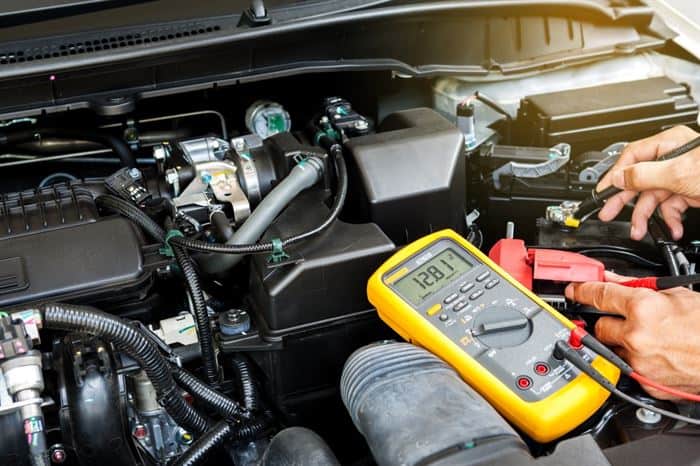
Another way to check how many volts a car battery has is by using a multimeter. These devices are inexpensive and readily available. So before checking, you should let the car sit for a while. You can leave your car overnight or longer, then test it. This is better than just testing it after the engine has been running. Otherwise, the result may not be accurate.
First, set the DCV to 20. Then, touch the battery’s negative terminal with the black wire and the positive terminal with the red wire. This will allow you to see the battery voltage on the multimeter’s display. The voltage should be around 12.4 to 12.6 volts. Anything lower than that tells you the battery is not fully charged.
An important thing to note is that if you see a negative reading, it simply means you have taken the leads the wrong way and are touching positive to negative, negative to positive. What you need to do is simply reverse them and touch them to the opposite terminals.
Car Battery Load Test
A functioning battery will generate between 9.5 and 10.5 volts over 30 seconds during load tests. A reading in this range indicates a healthy battery, capable of storing enough energy and running the car’s electrical devices smoothly. You will need a battery load tester to perform the inspection.
What should you do if the battery fails the load test and the voltmeter readings are below 12 volts at regular intervals? You can try to jump-start the car or boost its performance by adding distilled water. If both methods fail, you need to change the battery unit.

How Often Should You Test Your Battery?
So, besides the importance of knowing how many volts a car battery is, how to test car batteries, you need to know how often to test the battery. Just as your car needs frequent maintenance, the battery should also be checked. As specialists recommend, you should test the battery every 6 months.
If your car has a good battery and stable voltage, that’s good news. But what if the battery has a problem? By testing consistently, you’ll know what to do when the voltage is low. If you leave your car for a long time, for example, all winter, you should test the battery before taking it out and starting to use it.
Summary
So, you have the answer to the question: how many volts is a car battery? It’s supposed to be 12 volts DC. Learn how to test your car battery so you can check the battery voltage when needed. Remember to follow our maintenance tips to better understand your car and know how to care for it.