
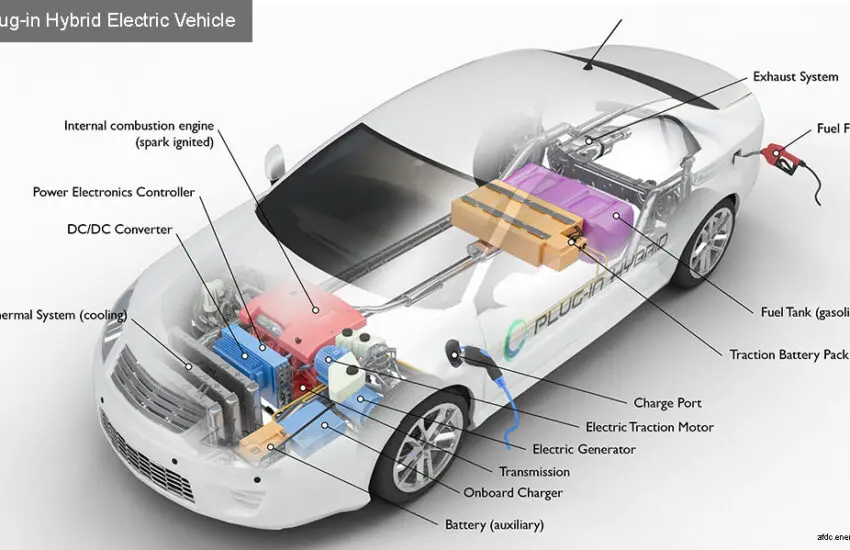
Plug-in hybrid electric vehicles (PHEVs) use batteries to power an electric motor and another fuel, such as gasoline, to power an internal combustion engine (ICE). PHEV batteries can be charged using a wall outlet or charging equipment, by the internal combustion engine, or through regenerative braking. The vehicle typically runs on electricity until the battery is nearly depleted, and then the car automatically switches to the ICE.

Key Components of a Plug-in Hybrid Electric Car
Battery (auxiliary): In an electric drive vehicle, the low-voltage auxiliary battery provides the electricity needed to start the car before the traction battery is engaged; it also powers the vehicle’s accessories.
Charge port: The charge port allows the vehicle to connect to an external power supply to charge the traction battery.
DC/DC converter: This device converts the high-voltage DC power from the traction battery into the low-voltage DC power needed to run the vehicle’s accessories and recharge the auxiliary battery.
Electric generator: Generates electricity from the rotating wheels during braking, transferring this energy to the traction battery. Some vehicles use motor-generators that perform both propulsion and regeneration functions.
Electric traction motor: Using energy from the traction battery, this motor drives the vehicle’s wheels. Some vehicles use motor-generators that perform both propulsion and regeneration functions.
Exhaust system: The exhaust system channels exhaust gases from the engine out through the tailpipe. A three-way catalyst is designed to reduce engine emissions within the exhaust system.
Fuel filler: A nozzle from a fuel dispenser attaches to the vehicle’s receptacle to fill the tank.
Fuel tank (gasoline): This tank stores gasoline on board the vehicle until it is needed by the engine.
Internal combustion engine (spark-ignited): In this configuration, fuel is injected either into the intake manifold or the combustion chamber, where it is combined with air, and the air/fuel mixture is ignited by the spark from a spark plug.
Onboard charger: It takes the incoming alternating current supplied via the charge port and converts it to direct current to charge the traction battery. It also communicates with the charging equipment and monitors battery characteristics such as voltage, current, temperature, and state of charge while charging the pack.
Power electronics controller: This unit manages the flow of electrical energy delivered by the traction battery, controlling the speed of the electric traction motor and the torque it produces.
Thermal system (cooling): This system maintains a proper operating temperature range for the engine, electric motor, power electronics, and other components.
Traction battery: Stores electricity for use by the electric traction motor.
Transmission: The transmission transfers mechanical power from the engine and/or the electric traction motor to drive the wheels.