
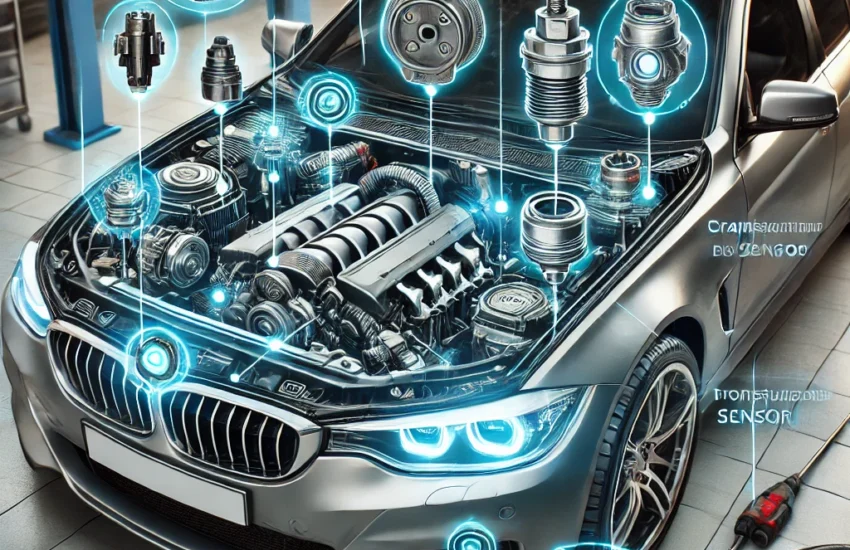
With technological advancements, modern cars have become true computers on wheels. Much of their performance, safety, and comfort relies on a multitude of electronic sensors. These devices measure various data and allow the vehicle to adjust its behavior in real-time. Here is an overview of the most essential sensors and their roles.
1. Mass Air Flow (MAF) Sensor
- Role: Measures the amount of air entering the engine.
- Importance: Allows the engine computer (ECU) to calculate the exact amount of fuel to inject for optimal combustion.
- Symptoms of failure: Loss of power, excessive fuel consumption, unstable idle.
2. Oxygen (O2) Sensor
- Role: Analyzes exhaust gases to measure the remaining oxygen amount.
- Importance: Helps optimize the air-fuel mixture and monitors the efficiency of the catalytic converter.
- Symptoms of failure: Increased emission of polluting gases, loss of engine efficiency.
3. Crankshaft Position (CKP) Sensor
- Role: Monitors the position and rotational speed of the crankshaft.
- Importance: Essential for managing ignition and fuel injection.
- Symptoms of failure: Difficult or impossible starting, engine stalling.
4. Camshaft Position (CMP) Sensor
- Role: Determines the position of the camshaft relative to the crankshaft.
- Importance: Coordinates intake and exhaust cycles for precise timing.
- Symptoms of failure: Irregular idle, loss of power.
5. Tire Pressure Monitoring (TPMS) Sensor
- Role: Measures the pressure in each tire.
- Importance: Ensures safe driving and reduces tire wear and fuel consumption.
- Symptoms of failure: Incorrect dashboard alert.
6. Engine Coolant Temperature (ECT) Sensor
- Role: Measures the temperature of the engine coolant.
- Importance: Helps the ECU manage engine cooling and adjust the air-fuel mixture.
- Symptoms of failure: Engine overheating, difficult cold starts.
7. Radar and Camera (ADAS) Sensor
- Role: Monitors the environment around the vehicle.
- Importance: Used for driver assistance systems (automatic braking, lane keeping, adaptive cruise control).
- Symptoms of failure: Malfunction of ADAS systems, false alerts.
8. Fuel Pressure Sensor
- Role: Measures the fuel pressure in the injection system.
- Importance: Ensures a constant fuel flow for efficient combustion.
- Symptoms of failure: Loss of power, starting difficulties.
9. Parking (Ultrasonic) Sensor
- Role: Detects obstacles around the vehicle during maneuvers.
- Importance: Facilitates parking and prevents low-speed collisions.
- Symptoms of failure: Missing or incorrect alerts.
10. Ambient Temperature Sensor
- Role: Measures the outside temperature.
- Importance: Influences the operation of the air conditioning and certain assistance systems.
- Symptoms of failure: Air conditioning malfunction or incorrect displayed data.
11. Fuel Level Sensor
- Role: Measures the amount of fuel in the tank.
- Importance: Provides information to the driver to avoid running out of fuel.
- Symptoms of failure: Incorrect fuel gauge reading.
Conclusion
Sensors are the eyes and ears of modern cars. They play a crucial role in vehicle diagnostics, performance, and safety. Taking care of these sensors and acting quickly in case of failure ensures optimal operation of your car.