
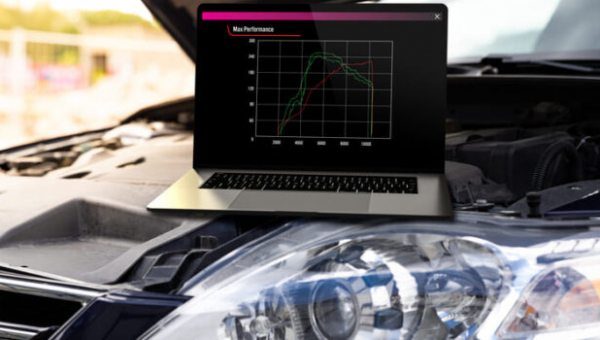

Ask someone to imagine what car maintenance and performance enhancement look like, and chances are they’ll think of a person in overalls covered in grease using various tools and fluids to modify the mechanical parts of an engine or replace an old, rusty part with a shiny, new metal one. Performance is traditionally seen as something that comes from enhancing a car’s mechanics—repairing, modifying, or otherwise tinkering with a vehicle’s physical components.
- 1 What is engine remapping?
- 2 Why might I need to remap my engine?
- 3 Will engine remapping benefit my car?
- 4 What are the risks of remapping?
For some time now, however, it’s not just upgrading the mechanics of car engines that can boost performance, but also electronic and computer technology, which is now an integral part of the cars we drive. In one of the opening scenes of “The Fast and the Furious”—the first installment of the extremely popular car movie franchise—drivers tap on their laptops, see graphics appear, and somehow alter the performance of their top supercars at the push of a button. It seemed like science fiction and something ordinary car owners would never experience. But it’s something we can experience. That something is engine remapping.
WHAT IS ENGINE REMAPPING?
Engine remapping (also covered under the general term “tuning” in the US or known as “chipping”) refers to the process of modifying your car’s engine computer or Engine Control Unit (ECU). “Maps” and “modes” are a range of data tables that take into account both what’s happening with the car in real-time and driver feedback to determine what to do with the engine. They are essentially computer algorithms that work in the background while you drive and impact many engine operations, such as ignition timing, sensors, air/fuel ratio, and turbo boost pressure.
Like software on a phone or laptop, this software that dictates how engine functions operate can be modified, rewritten, or overwritten to change how the car operates and optimize your car’s performance.
The ECU can be remapped to alter almost all of its functions in a way the driver might desire. Professional F1 or rally racing teams widely use engine remapping. They often have a variety of different engine maps that demand different things from the engine. For example, they can change the torque produced when the throttle is opened to account for the possibility of wheel spin when accelerating out of a corner, to handle rain, to account for high altitude, or maps to save engine power for qualifying laps. It’s all about customization.
For the average driver, this isn’t a realistic possibility, as it requires a lot of trial and error to tune an engine from scratch and determine how to affect the various parameters and reconfigure the software. Fortunately, engine remaps can be purchased and installed for you. You can choose from a range of generic engine remaps offering improvements or modifications, or custom remaps. By the time you have an ECU remap installed in your car, it has been thoroughly tested and developed to deliver optimal engine performance.
WHY MIGHT I NEED TO REMAP MY ENGINE?
The reason you might want to change how your car operates may not be immediately obvious. If the car is already installed with the manufacturer’s software, surely that gives the car optimal performance? That would make sense, but unfortunately, it’s not necessarily the case.
When a manufacturer develops a new car, they must account for all possible conditions a car will face in all the different regions where the car will be sold. Since most mainstream manufacturers target the global market, that’s a lot to consider. This means, therefore, that instead of simply optimizing the ECU software to deliver the best performance or fuel efficiency, they have to compromise on the map to account for these potentially different operating conditions. These conditions could include owners using substandard fuels, extreme temperatures or altitudes, different emission laws, and unfortunately, even the possibility that the vehicle isn’t regularly maintained according to the manufacturer’s recommended instructions. If they think poor-quality fuel or engine oil will be used,
A bit more cynically, it’s a relatively open secret that manufacturers program their models’ ECUs so that they don’t operate at maximum output. This is so they can release a “sportier” model with a more efficient engine by simply making small design changes. It’s also possible that performance was deliberately toned down before the car left the factory just to meet product planning targets and specifications.
WILL ENGINE REMAPPING BENEFIT MY CAR?
Remapping can enhance engine performance, which essentially means more speed and more power. The amount of fuel injected into the cylinders, the ratio between fuel and air, and when the spark plug ignites all affect the power you get from the engine. These are all things that can be changed if an engine is remapped, depending on how the programmers designed the remap.
For example, a recent study looked at the role of fuel injection pressure on performance and found that increasing the injection pressure increased engine power by about 12%. By increasing the injection pressure, the fuel particles became smaller, fuel atomization improved, and ignition occurred more quickly, resulting in more power on the piston, greater resulting torque, and a more powerful engine.
The proposed increase in horsepower—brake horsepower, of course, depends on what type of engine you have, but it could be an increase of up to 40 – 50bhp (brake horsepower) for a turbo engine and a bit lower for standard engines. This means that ultimately, the car doesn’t have to work as hard to produce excellent results and overall better performance. Many remapping services also offer a torque increase of up to 80 Nm (Newton meters), and ultimately, the car will feel much faster!
If the manufacturer has limited the power available to the engine or made the throttle less responsive to limit the torque produced in the engine, a remap can make the power delivery much more linear, which will make the vehicle more lively to drive and the engine more flexible.
Similarly, many proponents of remapping claim that it’s also possible to have a positive impact on a vehicle’s fuel efficiency. In theory, if the car has to do less work to operate at a normal level, then less fuel will be used to achieve that level of performance, and fuel economy will be improved. That said, however, it all depends on driving style. Rapid gear changes, sharp and quick accelerations, speeding, and sudden braking can have a negative effect on your fuel economy, increasing consumption by up to 40%. A sudden software change is unlikely to help counter that. The combination, however, of remapping and gentle driving will undoubtedly offer better fuel efficiency than good driving alone.
A good example of this might be that the improvement in torque produced by the engine after remapping means the driver no longer has to downshift to maintain speed (since more torque is available at a lower RPM range) on a slope or doesn’t have to change gears as frequently in traffic. All these small things contribute to an improvement in fuel economy.
WHAT ARE THE RISKS OF REMAPPING?
First of all, before we get carried away with the endless benefits of remapping, it should be noted that not all cars can be remapped, usually due to their age. Typically, cars produced before 2000 are too old and lack the necessary car remapping software to optimize vehicle performance. Those after, especially those after 2002 with OBDII, will be able to be remapped.
It’s also important to understand that remapping your own car is not advisable. Unless you work as a software developer in the automotive industry or are already an industry expert, there’s a lot that can go wrong if you do it alone. Choosing a reputable company to perform the remapping is the best way to avoid disaster. More established companies that provide a remapping service will offer a lifetime warranty on the replacement software, giving you a safety net if you notice problems in the future. If you try to remap yourself or don’t use an expert, the worst-case scenario is that your car’s ECU could be completely damaged, resulting in the engine shutting down entirely. A new ECU will be a very large expense afterward.
Engine remapping could also have a considerable knock-on effect on your insurance premiums. Historically, insurers were hesitant to insure any car that had been modified, and the price was increased if you had tuned your engine electronically. Nowadays, this isn’t always the case, but it’s very important that you inform your insurance company of this (or any other) modification. If you don’t, you risk making your policy invalid if you need to make a claim. It’s worth seeing how a remap would affect your premiums before proceeding with the procedure; increased performance may not be worth the price hike!
If you have a fairly new car, one of the biggest drawbacks is that remapping your engine will almost certainly void the manufacturer’s warranty. This isn’t necessarily a problem if the remap itself goes wrong, as you may have a warranty for the new software itself, but if something goes wrong with your car and the warranty isn’t valid, it would cause serious headaches. You can remap your car once the warranty has expired, or you can be prepared to take the risk—it’s up to you.
Finally, it’s possible that in trying to get great performance for your engine, you end up putting extra strain on it and could damage your car. As mentioned above, manufacturers will often limit an engine’s power and torque from the factory. The car’s standard tires, brakes, and suspension are suited to that chosen power output during the production process. So, if you wish to alter your car’s speed, it might not be able to safely handle the increase in speed and power.
With all these risks, opting for a new map for your engine might seem like a gamble. While this is true to some extent, with proper careful planning, research, and consideration, remapping an engine could allow you to achieve significant gains in performance, improve your fuel economy, and enjoy your driving even more than before.