
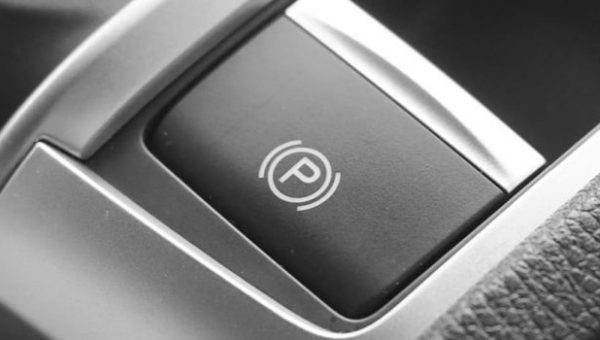

The electric handbrake, also known as the electric parking brake (EPB), is an innovative tool that was first installed in the 2001 BMW 7 Series. Since then, it has been slowly replacing the standard manual variant. Their basic functionality is similar, but instead of pulling a lever, as with a manual handbrake, the driver presses a button. An electronic control unit (ECU) then activates the holding mechanism that applies the brake pads to the rear wheels.
DESIGN AND FUNCTION

The operation of electric handbrakes tends to be very similar. Electronic handbrakes have an interface, usually a button, through which the driver can activate them, as well as an actuation mechanism. There are two main types of mechanisms by which an EPB can be engaged: cable-based and caliper-based. Cable pull systems work via a parking brake cable that activates the brakes when pulled. Electric parking brakes with integrated caliper systems instead use a motor-actuated brake caliper that engages the brakes.
In both cases, the signal from the interface is routed through a computer. This can either be part of the electric parking brake or integrated into the electronic stability control ECU.
ADDITIONAL FEATURES
Electric parking brakes have additional features that set them apart from ordinary handbrakes. Due to their electronic nature, electronic handbrakes are usually associated with a dashboard light indicating that the brake is engaged. Since the entire device is electronic, the driver can more easily tell that the car is securely held in place than with a manual parking brake.
EPBs can also be equipped with an automatic hold or hill start function. Electronic parking brakes with automatic hold prevent cars from rolling when stationary or when the driver is about to start. Hill start or hill hold functions work similarly but are specifically designed to prevent the car from rolling when starting on a slope.
HOW TO USE AN ELECTRONIC HANDBRAKE
The way the EPB is activated can vary from car to car, but it usually involves pressing the appropriate button and sometimes also pressing the brake pedal. Cars with manual gear selection typically require you to press the clutch as usual and then engage the accelerator pedal when releasing the first. Electric handbrakes that disengage automatically don’t even require pressing the button when starting.
A hill start with an electric handbrake is quite straightforward, although the exact way to disengage the electronic handbrake when starting the car on a slope varies. If the EPB supports hill starts, it disengages automatically after a few seconds from the moment you press the clutch and activate the accelerator pedal. Automatic cars naturally forgo the use of a clutch pedal. Electronic parking brakes that do not have a dedicated hill start function require the driver to find the right moment to press the button that releases the parking brake.
ADVANTAGES OVER STANDARD HANDBRAKES

Unlike standard handbrakes, electric parking brakes do not require additional muscle power to be used. They activate by pressing a button and lock the car securely. The risk of accidentally applying too little force to the brakes and causing the car to roll later is eliminated. Integrated caliper systems have the additional advantage of being less prone to freezing and brake cable wear. They also save space inside, as the lever mechanism is not needed. Their electronic nature also allows the system to warn drivers of malfunctions by illuminating the “Service Handbrake” indicator on the dashboard. Manual handbrakes typically require a serious malfunction or an undercarriage inspection to detect potential problems. Hill starts are also simpler and safer, whether the device explicitly supports them or not.
PROBLEMS WITH ELECTRONIC HANDBRAKES
Although electric parking brakes have many features that make them safer and more effective than manual handbrakes, they come with their own risks. Being an electronic unit, the EPB is prone to malfunction when the car’s electrical system voltage is low or other issues with the onboard network occur. A dead battery can prevent the brakes from receiving signals, leaving the car stuck in place. Malfunctions or damage to wires or fuses can also affect the electronic parking brake: open, shorted, or broken wires connected to the parking brake ECU can prevent it from functioning properly. Other common problems include the electric parking brake actuator seizing, electrical faults in the ECU, poor communication between different EPB modules, malfunctioning brake pedal switch or gear lever switch, etc.
Electric parking brakes sometimes have manual releases for these situations, but if the EPB does not release manually or automatically and you cannot easily determine the problem, a diagnostic tool is needed to figure out what went wrong with the device. Electric handbrakes are sophisticated mechanisms and difficult for amateurs to repair. An expert technician in a garage equipped to service your car’s make and model is usually required to resolve issues that arise. This applies to replacing brake pads and, of course, any work on the ECU itself.
Conclusion
Overall, an electric parking brake trades ease of repair for simpler activation and increased safety. The ease of use, additional safety, and space savings mean that EPBs will only become more common in the future.