
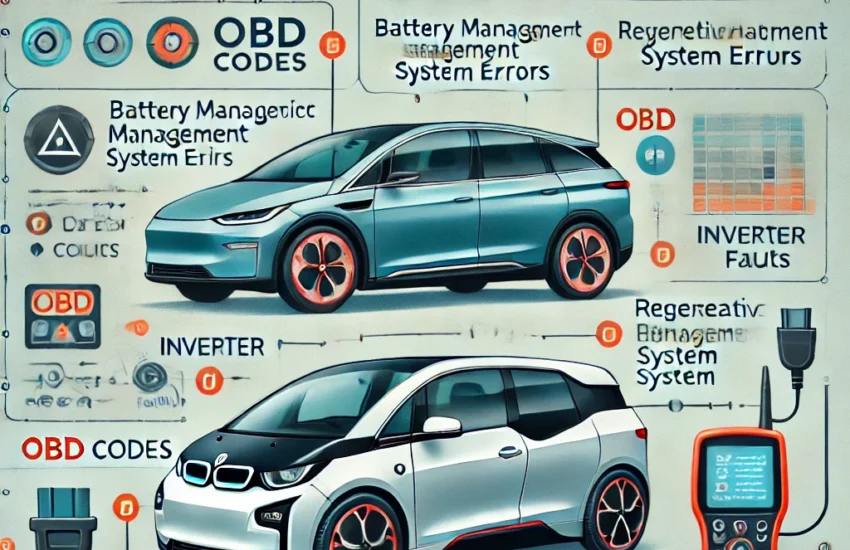
Electric vehicles (EVs) and hybrids don’t just replace the combustion engine with a battery: they introduce unique systems, monitored by specific OBD codes. These often little-known codes can signal critical problems like high-voltage battery faults, charging errors, or failures in the energy recovery system. Let’s decipher these codes and their implications together.
1. Why OBD Codes for Electric/Hybrid Vehicles Are Different
Novel Systems
- High-voltage battery: Thermal management, electrical insulation, charge cycles.
- Electric motor/generator: Torque control, energy recovery.
- Auxiliary systems: Electric air conditioning, battery heating.
Examples of Exclusive Codes
| OBD Code | Description |
|---|---|
| P0AA6 | High-voltage battery isolation problem |
| P1E00 | General hybrid/electric system failure |
| U0293 | Lost communication with battery module |
2. Deciphering the Most Common OBD Codes
Code P0AA6: Faulty Battery Isolation
- Causes: Moisture in the battery pack, damaged cables, component aging.
- Symptoms: Check engine light on, inability to charge, “Check electrical system” error message.
- Diagnosis: Measuring insulation resistance with a high-voltage multimeter.
Code P1E00: Hybrid/Electric System Failure
- Causes: Hybrid controller unit (HCU) failure, CAN communication problem.
- Actions: Check HCU module connections, analyze communication data with an advanced scanner.
Code U0293: Lost Communication with Battery Module
- Causes: Damaged CAN bus wires, faulty battery module, blown fuse.
- Solution: Inspect wiring and replace the module if necessary.
3. Essential Tools for Diagnosing These Codes
Compatible Scanners
- For amateur mechanics: ThinkCar ThinkDiag (access to battery data and high-voltage systems).
- For professionals: Autel MaxiSYS EV (comprehensive tests, reprogramming).
Safety Equipment
- Insulating gloves (Class 1000V).
- CAT III or IV multimeter for measuring high voltages.
4. Case Studies: Real Repair Examples
Case 1: Code P0AFA (Battery Cell Imbalance)
- Problem: Range loss on a Nissan Leaf.
- Diagnosis: OBD2 scanner + LeafSpy software reveals one cell at 2.8V (vs. 3.6V for others).
- Solution: Replacement of the faulty cell.
Case 2: Code P0BB1 (Faulty Charging Circuit)
- Problem: Unable to charge a Tesla Model 3.
- Diagnosis: Zero voltage at the charging port (blown charging fuse).
5. Mistakes to Absolutely Avoid
- Neglecting electrical safety: Not disconnecting the high-voltage battery before any intervention.
- Using an unsuitable scanner: Basic scanners cannot read EV-specific codes.
- Ignoring intermittent codes: A “pending” code can signal an imminent failure.
6. FAQ: Frequently Asked Questions
Q: Can an OBD code completely disable an electric vehicle?
A: Yes. For example, a P0A0A code (Serious battery fault) can prevent startup to avoid risks.
Q: How to clear a code on a hybrid vehicle?
A: Use a compatible scanner, but first identify the cause to prevent recurrence.
Q: Are OBD codes for hybrids similar to those for combustion vehicles?
A: Some generic codes (e.g., P0300) coexist, but hybrids have additional codes (e.g., P0A80 for the battery).
Conclusion
Electric and hybrid vehicles represent the future of the automobile industry, but their complexity requires a tailored approach. Understanding their specific OBD codes is essential to anticipate costly breakdowns and ensure safety. To deepen your knowledge, consult our guides on high-voltage battery diagnostics or tools dedicated to EVs.
Electric vehicles (EVs) and hybrids don’t just replace the combustion engine with a battery: they introduce unique systems, monitored by specific OBD codes. These often little-known codes can signal critical problems like high-voltage battery faults, charging errors, or failures in the energy recovery system. Let’s decipher these codes and their implications together.