
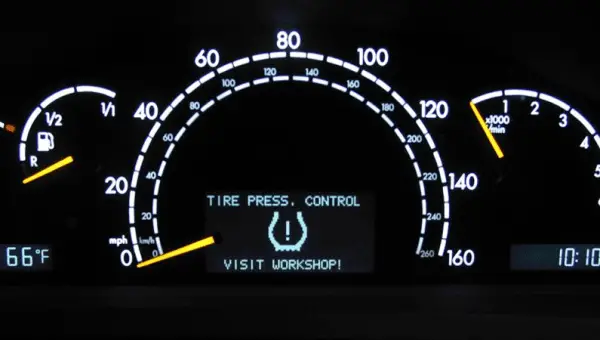
Causes of a Low Tire Pressure Warning Light
If you’ve ever been in a situation where you wondered, “Why is my tire pressure light on when my tires are fine?” you’re certainly not the first.
In the 1980s in Europe, a new technology was launched that significantly increased safety. The TPMS (or Tire Pressure Monitoring System) uses sensors on the vehicle to determine when a tire has low pressure and alerts the driver with a warning light so the tires can be checked.
The technology made its way to America and was so successful here that it became mandatory on all new vehicles after 2007 as part of the TREAD Act (Transportation Recall Enhancement Accountability and Documentation).
How Does TPMS Work?
Tire pressure is measured and sent to the ECU in several ways to alert the driver. Tire pressure is measured independently for each wheel, and some cars will even show you each individual tire pressure directly from your dashboard.
The direct system is used in the majority of cars. Each wheel has a physical tire sensor or transmitter, often attached to the inner part of the valve stem (where air is supposed to enter and exit the tire).
Indirect TPMS monitoring uses wheel speed sensors to provide information about tire rotation. The ECU analyzes this and sends a signal if one of the tires has low pressure, as it will rotate differently from the others.
If the TPMS Light Comes On
When the car starts, the TPMS light normally comes on for a second or two. This indicator often looks like a tire viewed from the front with an exclamation point inside. Sometimes it will simply say “TPMS.”
If a tire has low pressure, the TPMS light on the dashboard will illuminate. It may flash or stay on. If you see this while driving, pull over as soon as you can safely do so and check the tire pressure on all wheels. Fill each tire to the specified pressure in the manual or on the information panel on the inner door jamb.
Some vehicles have special signals to help you fill the tires correctly. Newer Nissan vehicles will beep the horn twice if the tires are overfilled.
Once you are certain that all tire pressures are correctly set, restart the car and continue on your way. Some TPMS lights turn off after a few miles, giving the ECU time to realize everything is fine.
If, however, you drive for more than about ten minutes and the light is still on, the sensors may need to be reset or recalibrated. It’s important to understand why the tire pressure light is still on before resetting it to avoid potential safety issues or vehicle damage.
Causes of the TPMS Light
If the tire pressure light remains on after you’ve driven for several minutes and ensured all tires are at the correct pressure, one or more of the following may be the cause.
1) Faulty TPMS Sensor (Direct Systems)
bad TPMS sensor
Physical sensors are prone to damage and also have a lifespan of about 5 to 10 years due to the battery built into each sensor. If a battery reaches the end of its life or if there is age-related wear on seals, gaskets, valve caps, or the sensor core, it may malfunction.
Another thing that can damage sensors is if a substance other than air or nitrogen is inside the tire. Tire sealants for puncture repair are one to avoid in tires with TPMS sensors, and tire shops often recommend replacing the sensor if a flat tire was repaired with Fix-A-Flat or something similar.
2) Faulty Wheel Speed Sensor, ABS, or ECU (Indirect Systems)
Wheel speed sensors are part of the ABS (Anti-lock Braking System), so if one of these or the ECU gathering the information is damaged, a signal may be sent to warn the driver of a problem that doesn’t exist.
Also read: Causes of a Traction Control Light Coming On
3) Ambient Temperature Changes
high intake temperature
Cold air is denser, so measuring or filling tires on a cold morning to the correct pressure means they are overfilled after some driving time or later in the day when it’s warmer.
Conversely, if you last checked the tires on a warm fall day and they were fine, a sudden cold snap can make the tire pressure too low (low enough to trigger the ECU).
Tire pressure drops about 1 psi for every 10-degree F drop in temperature because cold air takes up less space than hot air. Pressure in tires also tends to increase by about 3 psi while you’re driving due to the car warming up.
4) Recent Tire Rotation or Change
tire rotation
Since tires are moved to a new location on the car during rotation or new tires are installed (which may not have TPMS sensors), the car often requires a “relearning” process.
In some cars, this can be done simply by driving the car at a constant speed for 5 to 10 minutes, but others may require external recalibration by a tool or technician. Consult your owner’s manual for information regarding your specific vehicle.
A common issue is people buying a set of used tires that may not have TPMS sensors. For example, a set of winter tires in addition to the all-season ones that came with the vehicle may not have sensors or the correct sensors.
5) Low Pressure in the Spare Tire
low air pressure spare tire
Not all vehicles have TPMS in the spare tire, but those that do can trigger a tire pressure light sneakily when that tire is inevitably forgotten. This isn’t a bad thing, though; it’s always a good idea to keep the spare properly inflated in case you need it.
Resetting the TPMS
If the tire pressure light remains on after filling the tires, the light may need to be reset. The process for this varies significantly by car make and model. Sometimes you can find the exact procedure in the owner’s manual or by searching for your vehicle online.
Some vehicles don’t allow you to reset your own TPMS sensors without a special tool. Subarus are some of them: each TPMS sensor receives an ID that must be registered with the ECU along with the tire’s position, temperature, and pressure information at that time.
If there are changes to any of these elements (e.g., with tire rotation, tire change, or a recently filled tire), the sensors must be recalibrated with a special tool before the light turns off. This tool can be found at many auto repair shops, tire stores, and dealerships.
In Hondas, the tire pressure light only turns off when the system is recalibrated, but newer Hondas integrate this process into the touchscreen so the user can easily reset the TPMS using the manual.
Some newer Mazdas have a button you can hold down to turn off the TPMS light and prompt the system to relearn the tire pressures. Try not to overuse this feature—you should always check your tire pressure whenever the light comes on.
If you choose to go to a dealership or shop to have the TPMS reset, be aware that the law may prohibit them from letting the car leave if the light is still on once they start working on the wheels. They will likely resolve the issue, so it shouldn’t be a problem, but otherwise, your car could be held hostage until they can fix what’s wrong.
Conclusion
best tire pressure gauge
Most of the time, when the TPMS light is on, one or more tires have low air pressure. This system has prevented many accidents by alerting the driver to a flat tire before the vehicle loses control.
It’s important not to rely on TPMS for maintaining your tires. Tires are among the most critical components of your vehicle, as they are the only part of the car that actually makes contact with the road. Check the pressures at least once a month using a good tire pressure gauge. Tire pressure gauges are sold for a few dollars at any auto parts store and many big-box retailers.