
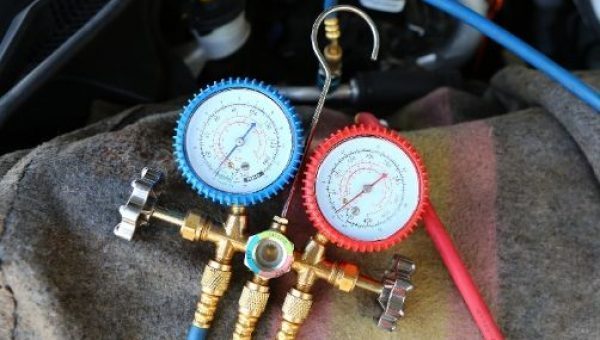

Being confident with your A/C compressor means it is operating at its optimal capacity.
But, being a component of refrigeration, it can also develop malfunctions.
If such a situation arises, you will need the interpretation of your A/C compressor unit.
A qualified technician can do this job for you. The technician must have the right tools and information about the A/C compressor.
One of the necessary tools is an information tool called a pressure chart. The pressure chart plays an essential role in identifying the problem in an A/C compressor unit.
In this article, let’s examine a type of pressure chart called the R134a low-side pressure chart.
Continue reading as you seek to find out what the R134a low-pressure chart is.
Before defining the R134a low-side pressure chart, let’s understand what r134a means.
So,
| Ambient Temperature (°F) | Low Side | High Side |
| 110° | 50 to 55 psi | 335 to 345 psi |
| 105° | 50 to 55 psi | 325 to 335 psi |
| 100° | 50 to 55 psi | 300 to 325 psi |
| 95° | 50 to 55 psi | 275 to 300 psi |
| 90° | 50 to 55 psi | 250 to 275 psi |
| 85° | 50 to 55 psi | 220 to 250 psi |
| 80° | 45 to 50 psi | 175 to 220 psi |
| 75° | 40 to 45 psi | 150 to 175 psi |
| 70° | 35 to 40 psi | 140 to 165 psi |
| 65° | 25 to 35 psi | 135 to 155 psi |
What does R134a mean?
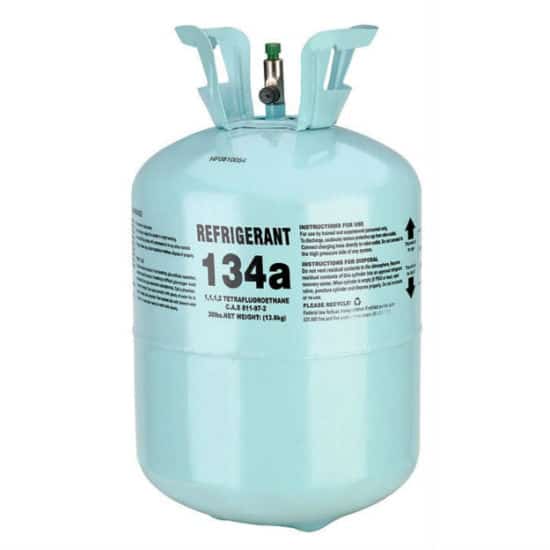
R134a is a refrigerant used in a wide range of household or industrial appliances. These household appliances are equipped with a refrigeration unit called a compressor.
Inside this compressor is an R134a refrigerant. The refrigerant allows the compressor to perform its function well.
Installing a gauge/meter helps in understanding the regular operation of this component.
The meter displays pressure readings relative to the temperature readings of the refrigerant. In this case, R134a is the refrigerant.
Recording these readings is done on a three-column table. We have the temperature column, the low side, and the high-pressure column.
Usually, we call the table the pressure chart. In this case, since the refrigerant is R134a, our chart will be the R134a pressure chart.
The R134a pressure chart indicates the pressure-temperature relationship with the R134a refrigerant.
The r134a chart comes in two forms,
- R134a low-side pressure chart.
- R134a high-side pressure chart.
The gauge/meter installed on the refrigeration component contains two meters/gauges. We have a low-pressure gauge and a high-pressure gauge.
For the low-side pressure chart, the readings come from the low-side meter. Similarly, the high-side pressure chart records come from the high-side gauge or meter.
So,
What is an R134a low-side pressure chart?

This is a chart detailing the relationship between pressure and temperature on the low side of the A/C compressor.
Is the R134a low-side pressure chart important? Yes.
How?
The technician uses this chart to determine if the A/C compressor needs a refrigerant recharge.
Similarly, it tells you if the compressor requires replacement. Therefore, it determines the condition of the A/C compressor system.
To identify that the A/C compressor unit is operating at its optimal, the technician uses the R134a low-side pressure chart.
Knowing what the R134a low-side pressure chart is can be a challenging task. Similarly, interpreting the reading on the charts is never easy. Remember, the measurement is against pressure.
Therefore, you need to understand what each reading means.
When interpreting this reading, you compare both the low side and the high side of the chart. But this article is about the R131a low-side pressure chart.
So, let’s focus on the low-side readings. Remember, we are comparing the pressure reading to temperatures.
How to read an R134a low-side pressure chart
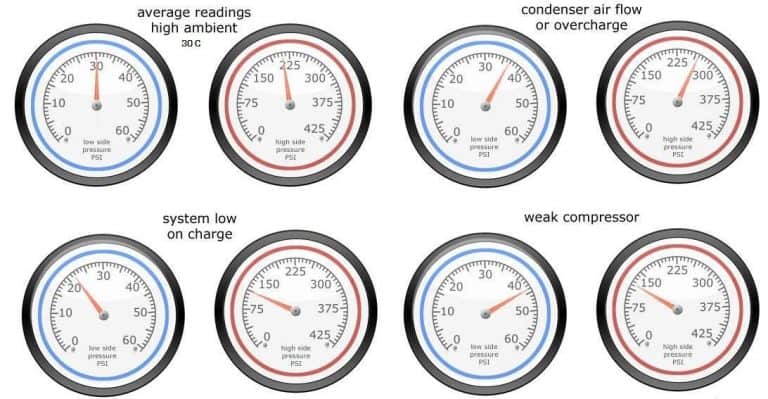
Well, let me guide you through the process.
Remember this; a performing compressor should have low readings on the low-side pressure chart.
This will indicate that the compressor is clean and there is maximum airflow.
This process will allow you to understand and interpret the readings on the r134a low-pressure chart.
- On the low side, the pressure is low relative to a high temperature. This should show you two things
- The A/C compressor system is not engaged. Therefore, there is a changing displacement in its operation.
- The compressor operation may be failing. So, you need to replace it with another one.
- When the pressure on the low side of the chart is high, check the following points.
- Check the condenser fan. It may not be working. Dirt is clogging, and thus there is an obstruction in the airflow.
- There could also be an obstruction of the refrigerant flow in the compressor.
- On the low side of the chart, the pressure is low while the temperature is high. This should mean the system is not operating at its optimal capacity.
- When you look at the R134a pressure chart, you realize the pressure is almost equal on both sides. Consider the following.
- The displacement function of the A/C compressor is not working and therefore needs to be checked.
- The A/C expansion valve may not be working.
In other words, the A/C compressor could be failing internally.
Wait a minute, I know you are now wondering and asking,
What are the normal operating pressures for R134a?

The pressure for a normally operating R134a is between 22 and 57 pounds per square inch (PSI).
Remember, there are two sides to the chart; we have the low and the high.
Therefore, in a normal R134a, the low-pressure side is 90 degrees or less and the PSI should be close to 30.
After going through all the details above, you are still wondering,
Why is my AC low-side pressure high?
As I mentioned in the reading interpretation part above, point number two to be precise.
High pressure on the low side of the pressure chart is not a good indicator. In other words, the A/C compressor unit of your appliance might be failing; therefore, it needs servicing.
Looking at it more closely, the technician should be able to note the following,
- The condenser fan may not be working due to clogged dirt. Thus, there is an obstruction in the airflow.
- The refrigerant could not flow properly.
A qualified person with the right tools can identify all the above issues.
Conclusion
The r134a low-pressure chart is essential for every technician. Whether for home inspection and interpretation or commercial interpretation.
The chart helps inspect, identify, and resolve issues resulting from the readings. If you are a technician, consider having it at all times.