


The necessity of changing the automatic transmission fluid in your vehicle at regular intervals is often overlooked, especially in regions like the United Kingdom where automatic transmissions are much less common than in the United States, for example. Most people know that their engine oil needs to be changed regularly. When it comes to the transmission, however, they might leave the fluid unchanged until things start to go wrong.
In other words: until it’s too late.
In truth, the automatic transmission can suffer from many problems that no oil change will prevent. But given the cost of repairing (or worse, replacing) an automatic transmission, it’s not worth risking the problems that an oil change can prevent.
Now, before we get into the when, let’s look at the why.
Why You Shouldn’t Ignore Your Automatic Transmission Fluid Change Interval
Automatic transmissions are very complicated beasts. A manual transmission is basic in comparison, and most things that go wrong with them are due to driver error, or at least exacerbated by the driver. With an automatic gearbox, however, you shouldn’t even be able to drive it “incorrectly,” for the most part. Maybe if you really tried.
There’s a lot more going on inside an automatic, and that means a lot more that can go wrong, no matter how you drive.
The oil in your automatic gearbox isn’t just a lubricant to keep those moving parts moving. It’s also responsible for powering the transmission’s internal hydraulics and keeping everything cool. In short, it goes everywhere.
Hydraulics
The magic of an automatic transmission happens mainly via hydraulics. Hydraulics is far more than I will cover here. In short, pressurized fluid moves components within the gearbox. This is achieved by directing said fluid through a number of small channels inside the gearbox. During circulation, your fluid may pass through gauze filters, metering valves, and a number of small orifices. Not to mention several larger components such as torque converters and transmission fluid coolers.
So,
Debris
The inevitable fact of a clutch is that it wears out over time. And automatic transmissions have several clutches. The clutch is meant to “slip.” But slipping causes some of the material from these clutches to rub off. This debris has nowhere to go but into the fluid itself. There are also other sources of debris within the gearbox, such as bearings and moving components that wear out over time.
Debris will get into your transmission fluid. It’s an unavoidable fact of operating moving parts.
Transmission fluid collects debris over time. If not changed, this debris can build up to the point where it can really cause problems for your transmission.
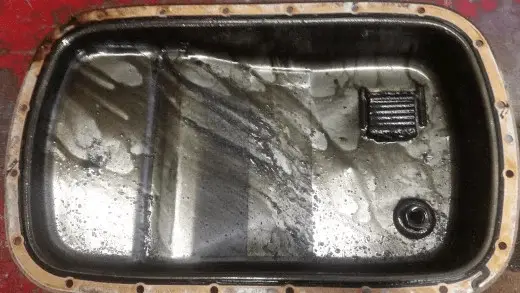
Transmission fluid collects debris over time. If not changed, this debris can build up to the point where it can really cause problems for your transmission.
You may have already pieced together the two important details here. Debris-filled fluid being forced through small channels, orifices, and filters is a recipe for disaster. As debris accumulates, it will begin to hinder the operation of certain parts of the gearbox. This can manifest as sticky valves, causing harsh or delayed gear shifting. It can cause completely blocked valves, resulting in the complete loss of one or more gears.
The worst outcome of this debris, however, is a major blockage of the transmission’s main filter. The filter is there to prevent this debris from recirculating through the transmission, but it also means that all the fluid passes through it. If all the fluid used to power the transmission goes through one point, which then becomes blocked… well, you get the idea.
Chain Reaction
A blocked filter can lead to a complete loss of drive from a gearbox on rare occasions. It’s more likely, however, that debris will build up slowly. A partially blocked filter will only partially starve the transmission of fluid, which is actually worse than letting it starve completely.
The fact that transmission fluid powers everything means that a transmission receiving no fluid cannot damage itself. A transmission with insufficient fluid may have enough power to partially apply the clutches. If a clutch isn’t applied correctly, it will slip more than it should, thereby causing more debris to enter the fluid. This causes the filter to clog faster, leading to a loss of drive.
The difference here is that a sudden filter blockage can be repaired with an oil drain and a new filter. A loss of drive that happens gradually will almost certainly require a full transmission overhaul.
You’ve resisted the urge to skip the service, but when should you do it?
I hope the previous section convinced you to stick to your automatic transmission fluid change interval, but what is the interval? It’s a bit more complicated. There are many automatic transmissions, and they all have different service intervals.
In General
The first thing to keep in mind is that overdoing it with automatic gearbox oil changes is never a bad thing. You won’t damage your transmission by changing the oil more often than the manufacturer recommends. The lower end for an automatic transmission fluid change interval is around 30,000 miles (a little under 50,000 km). If you can’t find the service interval for your particular transmission, you could do far worse than simply using this interval as a guide.
Other typical service intervals are 60,000 miles (about 96,000 km) and 100,000 miles (about 160,000 km). 60,000 miles is not an unreasonable interval. 100,000 miles is pushing it, however. If your transmission’s manufacturer claims their product is good for 100,000 miles between services, I would take their recommendation with a grain of salt, which brings me to our next point.
“Lifetime” Oil
Some transmissions, particularly in BMWs, claim to be sealed units that carry “lifetime” oil. The claim means that a) you shouldn’t open the transmission and b) it will never need a fluid change. Needless to say, you’re better off ignoring that claim. Chances are, “lifetime” oil claims are technically accurate on the basis that the transmission will fail mechanically before the oil needs changing.
The fact that your oil was still fine when your transmission imploded will be little comfort, however.
Filling an automatic transmission without a dipstick can be tricky if you don’t have the right equipment.
Filling an automatic transmission without a dipstick can be tricky if you don’t have the right equipment. | Source
Change It Anyway
As mentioned above, there’s really no downside to changing your automatic transmission fluid more often than recommended. Well, apart from the cost of a transmission service. However, mechanically, your transmission will thank you for it. The added benefit of regularly changing the fluid is that you (or your mechanic) can get a better idea of your transmission’s health. For example, if your transmission fluid is black and smells burnt, there’s likely an internal problem. It’s a very simple indicator of your gearbox’s health, but it can only be done if you get an oil sample.
It also offers you, or your mechanic, the opportunity to spot any fluid leaks from your transmission. Many of these leaks are very small and slow, and are easily missed as they don’t leave puddles of transmission fluid on the garage floor. It’s easy to check if the fluid is low on transmissions with a dipstick, of course. Transmissions without a dipstick will require you or your mechanic to be under the vehicle in order to change the oil so a visual check for leaks can be performed.
If your transmission has an oil dipstick (most modern transmissions don’t), it’s certainly worth at least checking the level and condition of your transmission fluid at least as regularly as the engine oil.
It never hurts to catch a transmission fault early.