
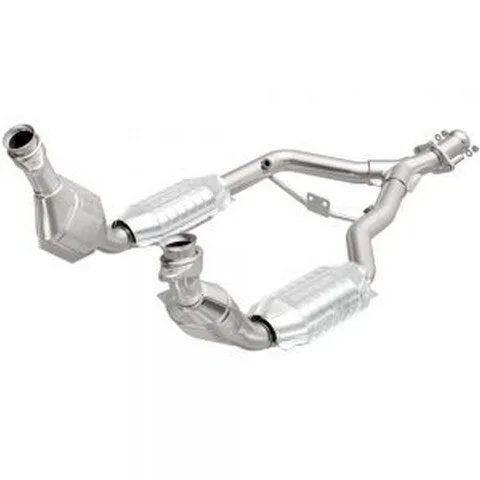
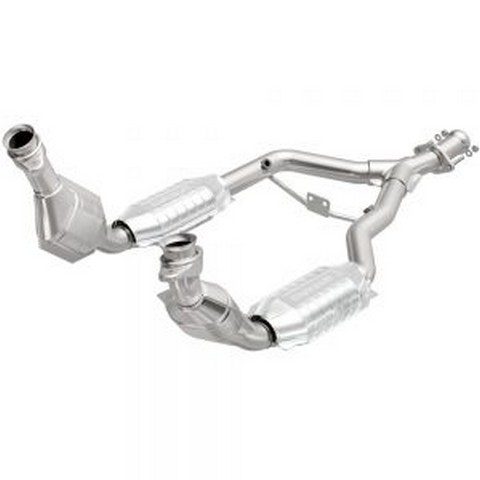
Your car’s catalytic converter is the centerpiece of the emissions control system, which unfortunately makes it one of the most dreaded and expensive potential repairs you might need. At its most basic level, the cat works as a filter on your exhaust system to reduce pollution coming out of your tailpipe. It’s designed to last the vehicle’s lifetime, but there are a few things that can cause it to fail prematurely.
There are very few things, from a functionality standpoint, that could alert you to a converter needing replacement. If the metallic element inside the converter cracks, it will make a rattling noise. You’ll see major driving issues if it’s clogged, but before it gets to that point, you’ll probably get a check engine light first, with the diagnostic trouble code (DTC) P0420 for “catalyst efficiency below threshold.”
While the code description distinguishes the catalytic element from the catalytic converter, the converter itself has no electronic input or output; this code instead comes from a difference between the air/fuel ratio measured by the upstream and downstream oxygen sensors. The oxygen sensors measure contaminants in the exhaust gases just before and after the catalytic converter to gauge its performance, and the signal they provide to your vehicle’s engine control unit (ECU) will cause the ECU to adjust the engine’s air/fuel ratio on the fly to ensure it’s operating within specifications.
My car has a Check Engine light with DTC P0420. Now what?
First, before giving technical advice, let’s start by warning that every car is different. While the following advice applies to most vehicles and is a great starting point for DIY mechanics, it’s never a bad idea to have a problem diagnosed by a professional before spending hundreds of euros.
Now, we’ve established that DTC P0420 is caused by a bad signal from your O2 sensors. This could be for one of two reasons:
The catalytic converter’s performance, as measured by your O2 sensors, is not what it should be
One or both of your O2 sensors are faulty, either due to an electrical defect or because the sensor probe is clogged with contamination from a vehicle that isn’t running properly.
A reasonable first step here would be to replace your O2 sensors, especially if you’re also getting a code diagnosing a potential electrical fault with them. While we generally don’t like advising to “throw parts at the problem,” it’s less wasteful in this case, because if the issue is with the catalytic converter and NOT the O2 sensors, a faulty catalytic converter could still contaminate the O2 sensors. If you install a new catalytic converter with old O2 sensors providing incorrect data to the ECU, it could prevent your vehicle from running as efficiently as possible and damage the new converter you just replaced. It would be a shame to replace a converter costing several hundred dollars, only for the new part to be poisoned by a $50 sensor that’s supposed to monitor its performance.
We always advise replacing the oxygen sensors at the same time as the cat, so it’s not an extra expense for parts. Worst case, it’s a bit of extra work, as the O2 sensors will likely be a bit easier to replace at the same time as the cat. But it’s possible that new O2 sensors will permanently resolve that check engine light.
One last diagnostic test that only works on downstream cats under the car: if you have access to a laser thermometer, go under your car (unfortunately only works when it’s at operating temperature) and use the thermometer to check the temperature of the exhaust pipe right before and just after the converter. If you see a large gap between the two numbers, it’s a clear indicator that the cat is clogged. However, this won’t test for a broken internal catalytic element and won’t work on manifold converters.
I replaced my O2 sensors and still have a Check Engine light. Now what?
That’s unfortunate, but something we were prepared for. This is the point where we advise having the vehicle diagnosed by a professional, because even if we’re sure it needs a new converter, modern cars will have between two and four converters total, and you may not need to replace all of them yet. Your most basic four-cylinder car will have two converters; an upstream converter (sometimes called the pre-cat) located on the exhaust manifold, and the downstream one located under the car. Cars with a V6, V8, V10, or V12 engine will have two upstream converters, as they have two manifolds, and one or two downstream converters. On non-turbo cars, the upstream converters are located on the exhaust manifold so they reach operating temperature sooner, which also makes installation a bit easier. Vehicles with a turbocharger have the upstream cat integrated into the turbo’s downpipe.