
Ground straps, also called ground wires or engine ground cables, perform an essential function in your vehicle. If there’s an electrical surge or short circuit in the engine, it diverts the excess electricity.
Without this part, the current could damage other parts of the car or its occupants. As with other electrical issues, a bad ground strap can be difficult to diagnose, but you can look for certain symptoms.
Can I drive with a faulty ground wire?
How a ground strap works
It’s simple. The wire runs from the chassis to the engine block or to the battery’s negative cable or terminal. The strap creates a complete circuit for all accessories that are connected to the engine block.
The systems in question here include sensors, the alternator, and the ignition system. Of the three, the alternator is the most voracious power user. It needs to be in order to recharge your car’s battery.
When a power surge occurs, the alternator’s ground diverts the current away from vital components. It is carried away and allowed to dissipate safely.
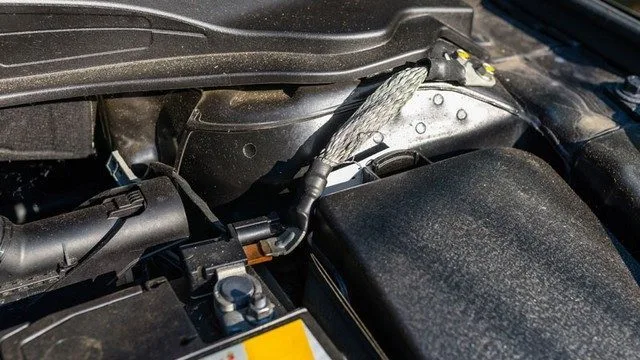
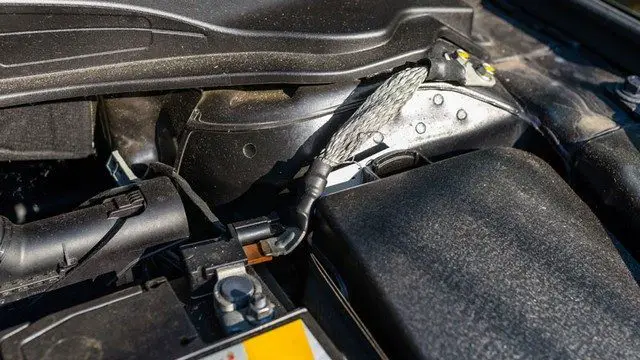
What a ground strap looks like
Before addressing the symptoms, we need to explain a bit what the wire looks like. We’ve called it a cable, but that’s not strictly accurate. It more closely resembles a bundle of braided steel strands.
Over time, with normal wear and tear, this braid becomes frayed. Individual strands begin to break and snap. It reduces the overall efficiency of the strap and will continue until it’s completely worn out.
Top 5 symptoms of a bad ground strap
As mentioned earlier, a bad ground wire can be difficult to diagnose. It causes many problems with your electrical system. These are similar to many other issues, so it can be hard to pinpoint the cause. Ask your mechanic to check the vehicle for a firm diagnosis.
Here are five of the symptoms you can expect:
1) Flickering lights
If the strap is loose, it can affect headlight performance. It results in uneven electrical surges that could cause the lights to flicker. Left as is, it will eventually cause permanent damage to the lighting mechanisms.
The bulbs are subjected to alternating power surges and drops. This exposure causes them to burn brighter and then dim. It’s not a serious problem if it happens once or twice, but frequent surges can cause significant damage.
If you think this is the issue, try to locate the ground cable. Make sure it’s securely in place. Sometimes, it’s just a loose connection. It could also be a problem if the cable wasn’t properly insulated, which might mean replacing the unit.
Check the cable itself and ensure it’s firmly in place. Look for cuts and fraying along its length. If you find several, it’s time to install a new unit.
2) Car battery not charging
Is your alternator working correctly? Then this could indicate a problem with the ground wire. It’s also wise to check the condition of your battery.
An old battery or one with faulty terminals won’t charge either. The issue here is the damage it can cause over time. The alternator requires a steady power supply to operate at its maximum efficiency, and if it doesn’t receive this, it can’t function effectively.
If the battery isn’t charging properly, it won’t last as long as it should. It’s essential to ensure this system is in perfect working order.
3) Low voltage
Is there low voltage in the vehicle? All you need is a simple voltage test to check this issue. If your battery is in good condition, you should get about 12.6 volts.
If your reading is lower, it’s a sign that the battery isn’t charging, which could also be due to a loose ground wire.
4) Car won’t start
If the ignition system doesn’t receive enough power, you can’t start your car. There are many reasons why this might happen, so do a basic check of fuel, battery, and ground wire.
If you hear a clicking sound, it means the solenoid is getting some power, but not enough. Whatever the reason, it won’t do you much good – you still won’t be able to start the car.
5) Visibly damaged strap
It’s wise to check the strap once a quarter or whenever you change your oil. Make sure it’s still secure and check the condition of the wires. If the cables have seen better days, it’s time to jump for a new unit.
Cost of replacing the ground strap
Fortunately, replacing the ground strap is very inexpensive. An engine ground strap is one of the cheapest parts you can buy. Expect to pay about $10 to $20 for a good quality strap.
Almost anyone can replace the strap itself. It simply involves disconnecting the negative ground wire from the battery, following it to where it attaches to the car, and disconnecting it from there. Then reverse the procedure by connecting the new ground strap.
If you want a professional mechanic to handle the replacement, the process is usually called battery cable replacement. It will likely cost you between $80 and $100 for labor, so you can quickly see the benefit of replacing the ground cable yourself.
Can I drive with a faulty ground wire?
Yes, you can. We want to emphasize the fact that this is only for short trips at a time, however. The problem is that the current can damage a number of systems in the vehicle. So, even though it won’t necessarily stop your car, it will cause even more damage if you ignore it.
The longer you ignore it, the worse the symptoms will become, and eventually, you’ll get in the car and won’t be able to start it at all.