
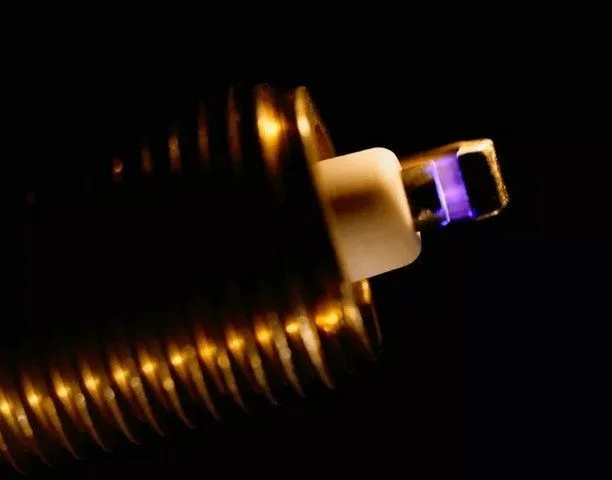
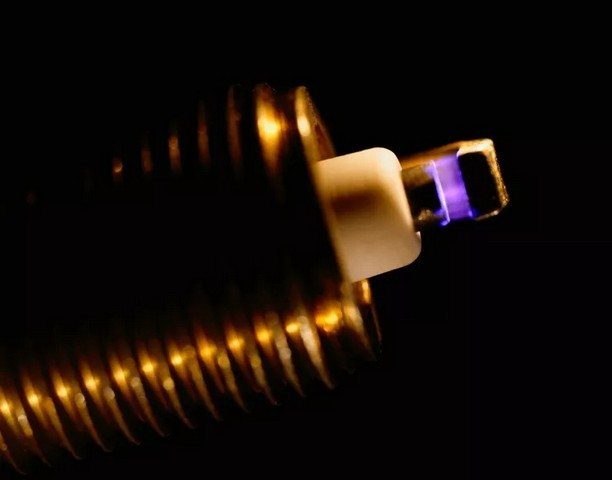
During its lifespan, an average spark plug can fire from 27.5 million to 110 million times. Each time, it vaporizes a few molecules from the spark plug electrodes.
Eventually, the gap between the spark plugs widens and the air-fuel mixture no longer ignites efficiently. Other engine problems could contaminate the plug and, under certain circumstances, it might not fire at all.
How the spark plug works
Fire requires three components: oxygen (O2), fuel, and heat. In your engine, each time a cylinder draws an intake stroke, it sucks in air (≈21% O2). Port injection engines inject fuel during the intake stroke, while direct injection, gasoline or diesel engines, may wait until the compression stroke. Finally, heat is provided in two ways: one or two spark plugs for gasoline engines, or compression heat for diesel engines. The result, as every time these three components are combined, is a tiny explosion. Cruising at 55 mph (88 km/h), the average cylinder fires about 1,000 times per minute, or 16 times per second!
In gasoline engines, heat is provided in the form of a tiny flash. High voltage, from 5 kV to 45 kV, depending on the vehicle, is generated in an ignition coil, controlled by a distributor or an engine control module (ECM). The charge is driven to the spark plug via a spark plug wire. The spark occurs when the charge jumps between the spark plug electrodes, only 0.01 to 0.07 inches (0.25 mm to 1.8 mm) in diameter. The heat generated, between 8,500 °F and 11,800 °F (4,700 °C to 6,500 °C), ignites the air-fuel mixture, driving the piston downward in the power stroke.
Signs of spark plug problems
How do you know if your spark plugs need attention? Your engine is a refined machine, and performance, fuel economy, and reliability depend on a constant supply of air, fuel, and spark. Here are seven signs of spark plug problems.
Fuel economy –
If you track fuel economy, as everyone should, spark plug problems could cause your engine to consume more fuel than usual. Since the ECM has no control over spark resistance or oxygen content, it adds fuel to compensate for poor combustion.
Misfire –
A cylinder misfire occurs when the plug cannot ignite the air-fuel mixture. This can happen due to worn spark plugs, contamination, cracked plug wires, or other issues.
Check engine light –
For many people, the check engine light may be the only sign that your engine has spark plug problems. The ECM is much more sensitive than many drivers and can detect a misfire in a single cylinder among thousands of good ignitions.
Hard starting –
Proper ignition is more difficult when the engine is “cold.” The ECM adds more fuel to account for poor vaporization, which can be hard for a worn spark plug to ignite, resulting in hard starting, long cranking, or a no-start condition.
Rough idle –
At idle, spark plug problems can be obvious, with more vibrations, essentially a cylinder misfire that occurs only at idle.
Poor performance –
During acceleration, spark plugs are under particular demand to provide a strong spark to ignite more fuel and generate more power. Faulty spark plugs or weak ignition coils may not meet the demand.
Hesitation / Surging –
Slightly less noticeable, hesitation on acceleration and surging could be described as the engine not “responding” immediately to the driver’s input. Then, a “surge” of power might occur unexpectedly. This slight delay in power delivery can indicate a spark plug issue.
Replacing spark plugs like a pro
Depending on the vehicle, engine, and type of spark plug, spark plugs typically last from 30,000 to 120,000 miles (48,000 km to 193,000 km). Spark plug wires and ignition coils tend to last a bit longer but usually don’t exceed double the lifespan of the plugs they power. For most vehicles, replacing spark plugs is a simple matter, but you might need to be a contortionist to access some of them, possibly placed behind shields or under intake manifolds and other equipment. Here are the basic steps for replacing spark plugs.
Accessing the spark plugs –
This may require removing other parts, such as engine covers, heat shields, or the intake manifold.
Remove the spark plug wire or ignition coil
– Before removing the wires, use tape or another method to mark the locations; otherwise, the plugs might not fire in the correct order. Replace any frayed, worn, or damaged wires or plug boots.
Blow out the spark plug channels –
Debris tends to accumulate in unprotected spark plug tubes and channels. Compressed air is a good idea to get rid of it, preventing it from falling into the cylinder when you remove the plug.
Remove the plug –
Using a spark plug socket and a locking extension, remove the old plugs.
Clean the plug threads –
A spark plug thread chaser is a great investment, and a few minutes cleaning the threads in the cylinder head can prevent future spark plug headaches.
Set the spark plug gap –
Most new spark plug gaps are preset at the factory, but it’s a good idea to check and adjust the spark plug gap according to the manual, just to be sure.
Lubricate the new spark plug –
Using just a bit of anti-seize lubricant, silver or copper doesn’t matter, lubricate the spark plug threads and the seal.
h2>Install the new spark plug – Hand-tighten the spark plug until it’s hand-tight, then tighten it according to specifications. Gasket types typically specify a quarter to a half turn after contact, while non-gasket types specify only one-sixteenth of a turn. Check the manual to be sure.
Reinstall everything else.
Being attentive is key to keeping a car reliable, and recognizing spark plug problems early can improve fuel economy and prevent you from being stranded. If you have questions about your spark plugs, be sure to consult a trusted professional.