
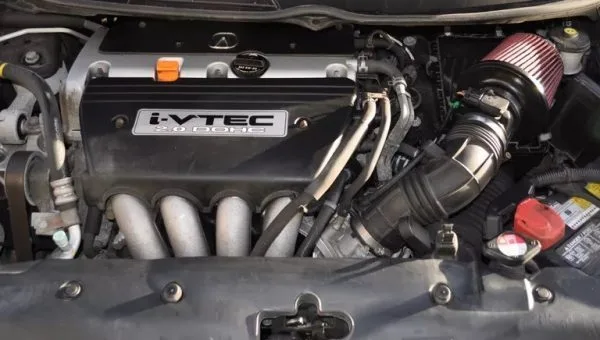
Every internal combustion engine, from tiny scooter engines to colossal ship engines, requires two basic things to operate – oxygen and fuel – but simply throwing oxygen and fuel into a container doesn’t make an engine. Tubes and valves guide the oxygen and fuel into the cylinder, where a piston compresses the mixture to ignite. The explosive force pushes the piston down, forcing the crankshaft to turn, giving the user mechanical force to move the vehicle, operate generators, and pump water, to name just a few of an automotive engine’s functions.
The air intake system is essential to engine operation, collecting air and directing it to individual cylinders, but that’s not all. By following a typical oxygen molecule through the air intake system, we can learn what each part does to keep your engine running efficiently. (Depending on the vehicle, these parts may be in a different order.)
The cold air intake tube is usually located in a spot where it can draw air from outside the engine compartment, like a fender, the grille, or the hood scoop. The cold air intake tube marks the start of the air’s passage through the air intake system, the only opening through which air can enter. Air from outside the engine compartment is typically lower in temperature and denser, thus richer in oxygen, which is better for combustion, output power, and engine efficiency.
Engine Air Filter
The air then passes through the engine air filter, usually located in an “air box.” Pure “air” is a mixture of gases – 78% nitrogen, 21% oxygen, and traces of other gases. Depending on the location and season, the air may also contain many contaminants, such as soot, pollen, dust, dirt, leaves, and insects. Some of these contaminants can be abrasive, leading to excessive wear of engine parts, while others can clog the system.
A screen usually catches most larger particles, such as insects and leaves, while the air filter captures finer particles, such as dust, dirt, and pollen. The typical air filter captures 80% to 90% of particles down to 5 µm (5 microns is roughly the size of a red blood cell). Higher quality air filters capture 90% to 95% of particles down to 1 µm (some bacteria can be about 1 micron in size).
Mass Air Flow Meter
To properly measure how much fuel to inject at any given time, the Engine Control Module (ECM) needs to know how much air is entering the air intake system. Most vehicles use a Mass Air Flow (MAF) meter for this purpose, while others use a Manifold Absolute Pressure (MAP) sensor, usually located on the intake manifold. Some engines, such as turbocharged engines, may use both.
On vehicles equipped with a MAF, air passes through a screen and vanes to “straighten” it. A small portion of this air passes through the sensor part of the MAF which contains a hot wire or hot film measuring device. Electricity heats the wire or film, causing a decrease in current, while the airflow cools the wire or film, resulting in an increase in current. The ECM correlates the resulting current flow with the air mass, a critical calculation in fuel injection systems. Most air intake systems include an Intake Air Temperature (IAT) sensor somewhere near the MAF, sometimes part of the same unit.
Air Intake Tube
After being measured, the air continues through the air intake tube towards the throttle body. Along the way, there may be resonator chambers, “empty” bottles designed to absorb and cancel out vibrations in the airflow, smoothing the airflow on its way to the throttle body. It’s also good to note that, especially after the MAF, there must be no leaks in the air intake system. Allowing unmeasured air into the system would skew the air-fuel ratios. At a minimum, this could cause the ECM to detect a malfunction, setting Diagnostic Trouble Codes (DTCs) and the Check Engine Light (CEL). At worst, the engine may not start or run poorly.
Turbocharger and Intercooler
On vehicles equipped with a turbocharger, the air then passes through the turbocharger’s intake. Exhaust gases spin the turbine in the turbine housing, spinning the compressor wheel in the compressor housing. The incoming air is compressed, increasing its density and oxygen content – more oxygen can burn more fuel for more power from smaller engines.
Because compression increases the intake air temperature, the compressed air flows through an intercooler to reduce the temperature and reduce the risks of engine knock, detonation, and pre-ignition.
Throttle Body
The throttle body is connected, electronically or by cable, to the accelerator pedal and cruise control, if applicable. When you press the accelerator, the throttle plate, or “butterfly” valve, opens to allow more air to flow into the engine, resulting in increased engine power and speed. When cruise control is engaged, a separate cable or electrical signal is used to operate the throttle body, maintaining the vehicle speed desired by the driver.
Idle Air Control
Intake Manifold
Intake Valves
As you can see, the air intake system is slightly more complicated than a simple tube going to the throttle body. From outside the vehicle to the intake valves, the intake air takes a winding path, designed to deliver clean, measured air to the cylinders. Knowing the function of each part of the air intake system can also make diagnosis and repair easier.