
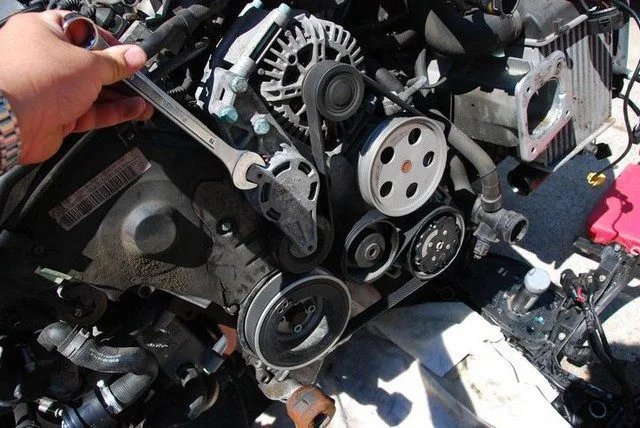
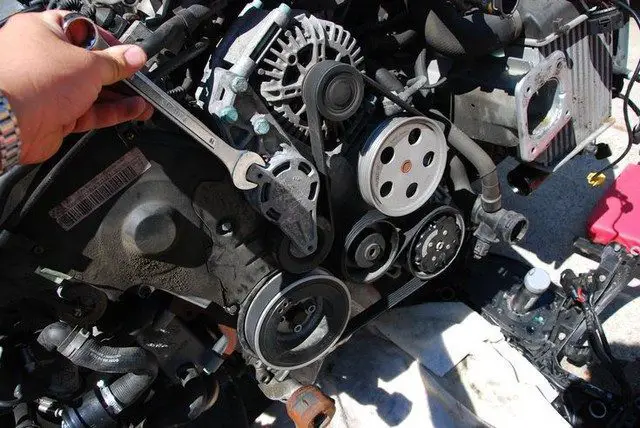
This is a single ribbed belt that drives all accessories, air conditioning, power steering, alternator, and various other pumps and accessories. They shouldn’t require any maintenance unlike their predecessors, the V-belt which needed periodic adjustment. But the fact is they don’t last forever and need to be inspected often to prevent you from getting stranded. If it starts to go bad, you can replace your serpentine belt at your convenience and not when the belt decides for you. Checking the ribbed drive belts at every oil change and the position of the self-adjusting mechanism indicator will ensure you catch a bad belt long before it breaks.
All About the Serpentine Belt
Look for tears or scrapes. If you see them, it means the serpentine drive belt is rubbing against a pulley flange or bolt as it wraps around. This will happen more often as the drive belt ages. If this occurs, you may need to file a smooth pulley flange or bend something.
Also look for pinholes and/or bumps. If you see them, it means dirt and debris are getting between the serpentine drive belt and the pulleys. Turn the belt over and see if any rib pieces are missing. You can start the engine to expose sections of the belt while you inspect. A few small, widely spaced pieces are fine, but if there are many and/or close together, replace the serpentine drive belt. Hairline cracks are normal, but if they go into the backing or flat side of the serpentine drive belt, you’ll need to replace it.
A good rule of thumb for serpentine drive belts is that if cracks are observed at 3 mm (1/8 inch) intervals all around the belt, the belt may be reaching the end of its useful life and should be considered a candidate for replacement. Small cracks spaced at larger intervals should not be considered as indicating the belt needs changing. However, the onset of cracking usually indicates the belt is only halfway through its service life.