
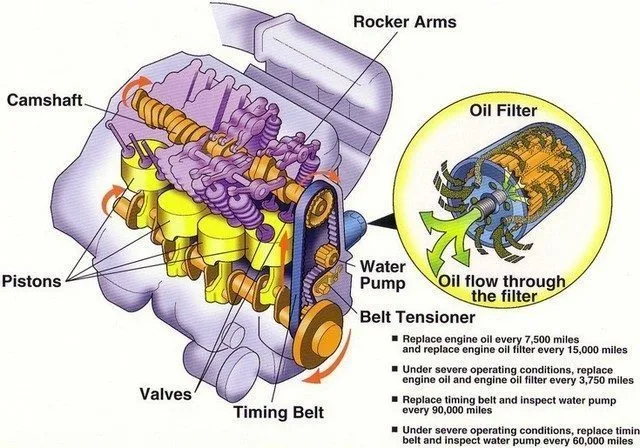
Have you ever wondered how an engine works? Let me explain it to you.
The engine components are as follows:
- Valves and rocker arms
- Pistons
- Cylinders
- Connecting rods
- Combustion chamber
- Camshaft
- Timing belt
- Crankshaft
Most gasoline engines operate in the following order:
Intake, compression, power, exhaust. Hence the name four-stroke.
V6EngEXP
V-6 Engine
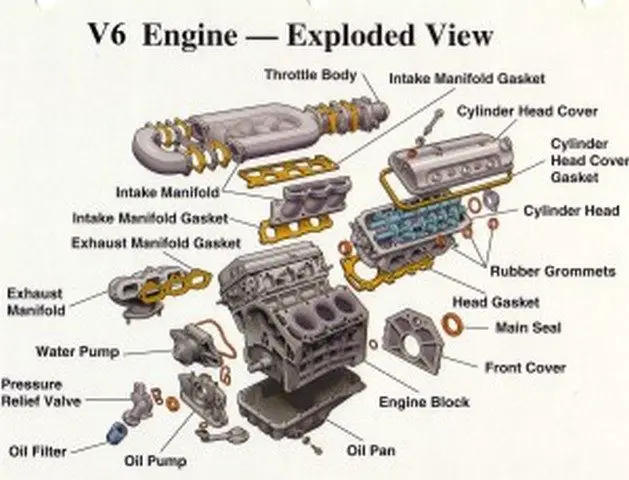 INTAKE VALVES are devices that allow a fuel/air mixture to enter the COMBUSTION CHAMBER at a very specific time and duration. Exhaust valves open during the exhaust stroke to allow spent gases to exit the engine. Each car uses a system to open and close the valves. Most Hondas use adjustable CAMSHAFTS and ROCKER ARMS to operate the valves. Some use hydraulic rocker arms to operate the valves. The difference is that hydraulic rocker arms are virtually maintenance-free, while solid rocker arms require periodic adjustment.
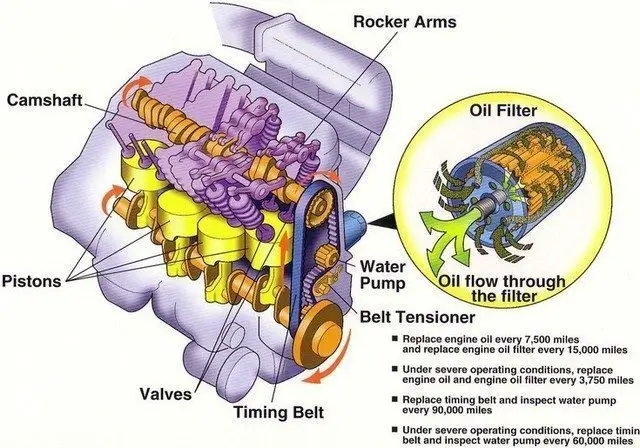
The camshaft is a thick, lobed bar on which the rocker arms roll. They are designed to open and close the valves to optimize the intake and exhaust processes for maximum power and efficiency. Some engines use multiple camshafts to allow the engine to accommodate more valves per cylinder. More valves per cylinder generally mean more power and better efficiency.
Engine1
Engine close-up
PISTONS are circular devices with a relatively flat top that move up and down inside the CYLINDERS to compress the fuel/air mixture after it enters the combustion chamber and expel the spent gases after combustion. The surface volume when the piston is at the top of its stroke multiplied by the number of cylinders determines the size of that particular engine. The gas explosion during the compression stroke forces the pistons downward. This process is repeated sequentially for each cylinder based on when its piston reaches the top of its compression stroke.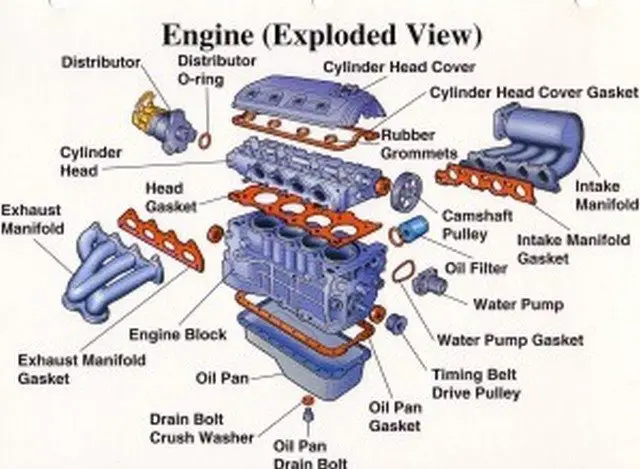
The TIMING BELT is a fiberglass and rubber belt driven by the CRANKSHAFT, rotating the camshaft at exactly half the crankshaft speed. The timing of the connection is crucial for the engine’s proper operation. The timing belt requires periodic replacement and regular adjustment. The crankshaft is a heavy rotating shaft that connects the pistons through the CONNECTING RODS. The crankshaft drives the transmission, producing power to drive the car. The weight of the crankshaft is typically exactly the same as that of the connecting rods and pistons. Newer Hondas have larger pistons. To make the engine as smooth as a 6 or 8-cylinder engine, the Honda engine uses two rotating balance shafts inside the engine. These balance shafts compensate for the weight of the larger pistons, resulting in a very smooth idle. The crankshaft is driven by the force of the mixture explosions during the compression stroke. The compression stroke of each cylinder, in turn, creates an engine that runs well at all speeds. The more cylinders an engine has, the smoother it runs and the more power it produces.
When you turn the ignition switch to the start position, several things happen simultaneously. The starter rotates the crankshaft at about 100 rpm. This allows the piston to compress the air/fuel mixture in the cylinder enough to create more pressure from the explosion when the spark plug fires, forcing the piston down and turning the crankshaft. The engine starts, and the idle stabilizes. When you press the accelerator pedal, the engine speed increases, more fuel/air mixture is injected into the cylinder, which speeds up the engine.
The carburetor or fuel injection system controls the amount of fuel/air mixture drawn into the engine based on the pressure on the accelerator pedal. In a fuel-injected engine, only the amount of fuel/air mixture that the engine can use at that particular moment is drawn into the combustion chamber, regardless of the pressure on the accelerator pedal. The fuel injection system also limits the engine speed by cutting off the fuel supply to the injectors. Usually, this limit is the engine’s redline. When the ignition is turned off, the fuel is cut off, killing the engine.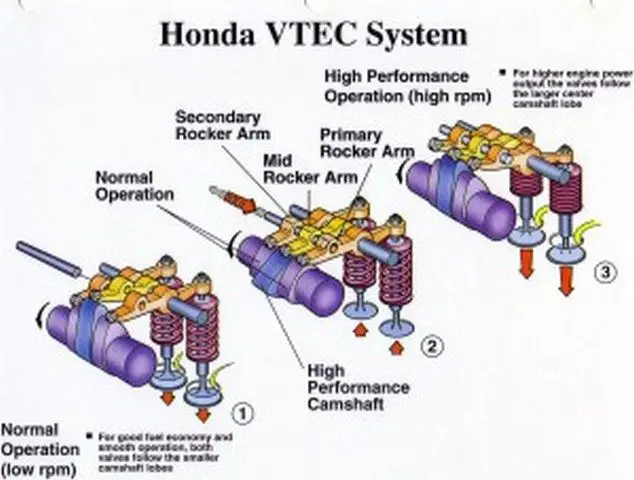
Honda’s latest engine is the i-VTEC I direct injection engine. For a small engine (2.0 L), it is capable of high mileage, more torque, and more horsepower while running cleaner than any previous engine. This short video explains how this new engine works: