
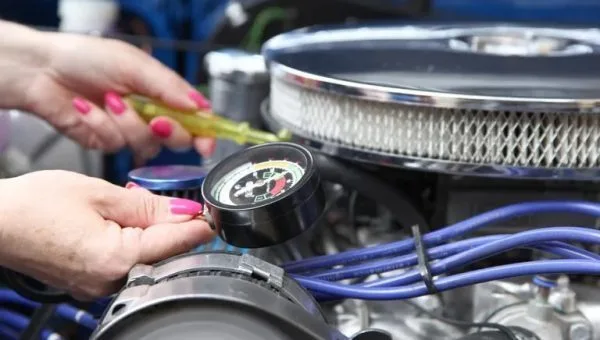

If your vehicle has an engine vacuum leak, the air-fuel ratio in your engine will be higher than 14.7:1, also known as a “lean” mixture. This ratio means there is too much air in your engine, and as a result, the engine will run poorly or not at all. If you think your vehicle has a vacuum leak, read on to learn about the most common symptoms and how to fix them.
Common Symptoms of an Engine Vacuum Leak
Engine vacuum leaks are typically associated with the following symptoms, but keep in mind that this list is not exhaustive.
Engine Operation Issues
An engine with a vacuum leak may potentially run normally, but it may idle faster than usual, idle roughly, misfire, hesitate, or stall. You may find that your vehicle does not accelerate as well as usual. Significant intake leaks could prevent the engine from starting.
Fuel Economy and Emissions
The lean air-fuel ratio will burn hotter and increase the generation of oxide emissions, such as nitrogen oxide (NOx) and sulfur oxide (SOx). Even if the check engine light is not triggered, the vehicle may still fail emissions tests. Drivers would also notice reduced fuel economy when the engine controller attempts to compensate by adding more fuel. The Evaporative Emission Control (EVAP) system also relies on vacuum to function, so a vacuum leak in an EVAP valve or tube can set an emissions diagnostic trouble code (DTC).
Check Engine Light
The Engine Control Module (ECM) constantly monitors the environment in the engine. Using the Manifold Absolute Pressure (MAP) sensor or the Mass Air Flow (MAF) sensor, among others, the ECM modulates the fuel injector pulse, spark timing, and valve timing. In the event of a vacuum leak, the ECM may not be able to compensate. Short-term or long-term fuel trim, STFT or LTFT on a scan tool, may display something like +10% or +25% when the ECM attempts to compensate for the unmeasured air. P0171 and P0174 are common Fuel System Lean DTCs.
Damaged Engine
At worst, long-term driving with a vacuum leak, the high temperatures generated by a lean air-fuel ratio could damage the engine. Lean mixtures can detonate and damage pistons and bearings. Higher-than-normal exhaust temperatures can also cause the catalytic converter to melt.
Other Outcomes
Depending on where the vacuum leak is located, it could lead to various other problems. Some fuel pressure regulators are modulated by vacuum and thus jump to high pressure when vacuum is lost. This could lead to fuel trim issues and a check engine light, possibly with rich fuel DTCs, such as P0172 or P0175. Some older power steering systems control engine idle using a vacuum switching valve (VSV), but a vacuum leak can stall the engine during a parking maneuver. Many vehicles use a vacuum-powered brake booster, which reduces braking effort, but a vacuum leak here could make it harder to stop your car.
Identifying an Engine Vacuum Leak
There are several methods you can use to identify a vacuum leak. Start with a vacuum hose diagram, which you can find in a repair manual or sometimes on a sticker under the hood. Using one of the following methods, searching for the vacuum leak may result in a change in engine speed or idle operation. Small leaks may only show up as fluctuating STFT readings on a scan tool.
Visual Inspection
A visual inspection is a good way to start, especially with vacuum hoses and tubes. Exposed to extreme temperatures under the hood and oxygen in the atmosphere, rubber vacuum hoses and plastic vacuum tubes can become stiff or brittle, crack, or break easily. Similarly, the engine’s rubber intake tubes can also become brittle, crack, and pave the way for unmeasured air to enter the system. Physically manipulating these components with the engine running can reveal the leak.
Water Method
This is the simplest and cheapest method, as it just uses a simple spray bottle of water. With the engine running, spray water around suspected vacuum leak areas, such as vacuum hose connections, intake manifold gaskets, and throttle plate rings. A vacuum leak will suck in the water, temporarily “sealing” the leak. This small amount of water will not damage your engine.
Carb Cleaner
Another method is to use a can of carburetor cleaner or aerosol intake cleaner. Please note that carb cleaner is flammable, so caution is needed and a fire extinguisher should be kept handy. Sparingly spray the cleaner onto suspected vacuum leak areas while the engine is idling. If the leak is detected, the engine will likely smooth out because the flammable mixture compensates for the lean air-fuel ratio.
Propane
Mechanic’s Stethoscope
Bubble Test
Smoke Machine
Once you have identified the source of the leak, the obvious solution is to repair it, but this is not always a simple fix. Vacuum hoses can be replaced easily, as can sensor or tube O-rings, and some valves are also easy to replace. Other vacuum leaks might be more challenging and time-consuming, such as intake manifold gaskets or a faulty brake booster. As always, if you feel the job is beyond you, consult your trusted local mechanic for professional assistance. Remember to reset the check engine light when you have completed the repairs.