
If your routine involves a lot of time behind the wheel or in the back seat of unfamiliar cars, you might be wondering how best to protect yourself from the coronavirus pandemic. You want to protect yourself and your clients from accidental transmissions.
We asked an expert how to keep a car clean without damaging the interior.
Take our fleet, for example. At the office, we often have half a dozen manufacturer-provided vehicles rotating each week, with as many staff members taking turns behind the wheel. That’s a lot of cars driven by a lot of people, and keeping them as germ-free as possible is a challenging and time-consuming task.
When it comes to disinfecting an interior, the potential for unwanted interactions can be daunting, especially since some cleaning ingredients can permanently damage the materials that make up your cabin.
The good news is that keeping your car’s interior free of harmful viruses and other unwanted elements is actually quite simple if you follow a few guidelines. Since we’re a bunch of car geeks, we reached out to an industry expert in cleaning chemistry. She works for an international chemical and consumer products company and did not want to be named for this article, but she kindly gave us some cleaning tips.
The key?
“Basically, good old soap. Soap chemically interacts with the virus’s surface in a way that degrades it very quickly and fundamentally destroys the virus,” she said.
If you’re used to an environment where hand sanitizer use is encouraged, this might seem counterintuitive, but while alcohol-based products like the garden-variety Purell can do a great job removing microbial threats, they’re not actually ideal for car interiors.
Conveniently, soap is a key ingredient in many readily available items—classic liquid hand or dish soaps (think Dial), for example. The trick is to avoid cleaners labeled as detergent-free.
If you’re already sitting on a stash of car cleaning products, you’re probably in good shape. Basic Armor All wipes, for instance, contain a mild detergent.
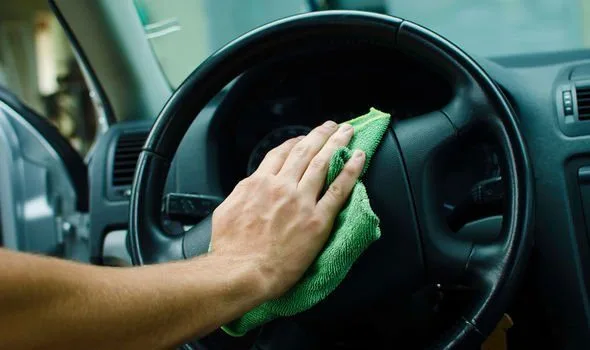
For those with leather interiors, facial cleansing wipes (like the Biore wipes pictured above) are an excellent solution; that’s because skincare products typically contain moisturizers, which are good for organic trim materials.
“Unlike our skin, which has the ability to self-moisturize, your interior cannot,” she said.
Alcohol and detergent-based cleaners can dry out organic materials. In other words, if it leaves your hands dry after use, it’s likely to also deplete the natural oils in your car’s leather interior.
If you don’t have access to detergent-based cleaners that contain moisturizers, or if you plan to use an alcohol-based cleaner, you can mitigate the drying effects with leather conditioners. These will replenish the oils that your cleaning process has depleted.
As a bonus, leather conditioners usually contain surfactants, which are the chemicals that help cleaners do what they do. They reduce the surface tension of water, helping it penetrate places it otherwise wouldn’t. In other words, they make water wetter.
Have you ever used dish soap to clean a tent, only to find it made water seep through the material? Congratulations, you already know how surfactants work, and they do the same thing to the outer layer of the coronavirus, effectively neutralizing it.
However, you shouldn’t rely solely on conditioners to keep your leather surfaces virus-free, and you shouldn’t use them excessively, as they will leave the leather greasy if you saturate it. If you use a product advertised for cleaning and treating interior surfaces, make sure its packaging states it’s safe for leather.
Regardless of what you use and how you use it, remember to wipe down surfaces after cleaning them. Even milder cleaners shouldn’t linger on your interior materials.
For those without real leather, there’s more good news. While these vinyl or other synthetic interiors shouldn’t be cleaned with alcohol or bleach-based cleaners, they have an advantage: they are much easier to disinfect.
“They don’t absorb anything, so once you clean the surface, it’s clean,” she said.
What about other surfaces, or items like key fobs and such, which might not have been built to the same rigorous standards as high-traffic interior trims?
“Painted surfaces won’t like alcohol but will generally tolerate bleach well. Vinyl-coated surfaces—many ‘chrome’ surfaces are actually vinyl coatings—won’t do well and the finish will be damaged. Simple plastics may tolerate bleach well,” she told me.
What else should be avoided besides bleach?
“All solvents (alcohols, acetone, kerosene, etc.) should be avoided, not only because they can damage expensive interior elements but also because they don’t really affect viruses,” she said.
If you use household cleaning wipes such as those made by Lysol or Clorox, absolutely avoid anything with bleach. And be wary of spray disinfectants (again, Lysol), as they only work through direct contact. If you miss a spot, you might as well have used nothing at all.
She also gave advice to those who, like us, might frequently switch cars that we don’t own.
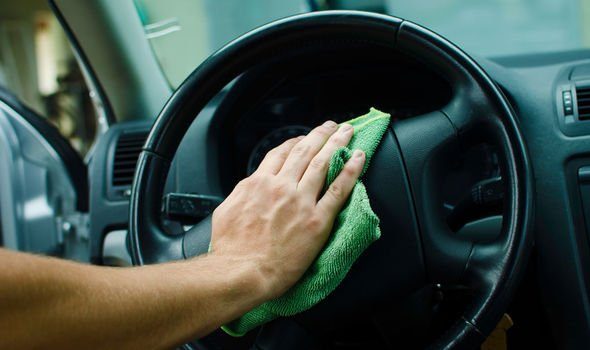
“Focus on the steering wheel, control stalks, gear shifter, and infotainment interface,” she said. “The rearview mirror also deserves a wipe, [and] don’t forget the gas cap!”
If you’re running low on supplies, you can probably afford to skip seat surfaces, as they don’t really touch the parts of your body likely to come into contact with viruses. Unless, of course, you’re driving for a ride service like Uber or Lyft.
“Those drivers have it the worst,” she said.
The best advice she gave to those who transport passengers for a living is to do so in a car with the simplest, easiest-to-clean interior. Plastic dashboards and vinyl seat surfaces are much easier to clean than those adorned with more sophisticated materials. It’s as if taxi fleets knew what they were doing or something.
So, when cleaning your car’s interior, keep these tips in mind:
- Soap is always your best bet. It is harmful to the coronavirus.
- Avoid bleach except on simple plastics.
- Do not use solvents.
- Hand sanitizers contain alcohol, which can dry out leather. Use a leather conditioner to keep it healthy.
- When in doubt, test cleaners on a surface that can’t be easily seen first.
- Wipe down what you wipe; don’t let chemicals linger.
- Prioritize surfaces you touch. Don’t forget buttons and switches, your rearview mirror, even your gas cap.
- Ride-share drivers should stick to basics. Simpler interiors are the easiest to clean.